Friday, January 4, 2008

South Thailand seacanoeing


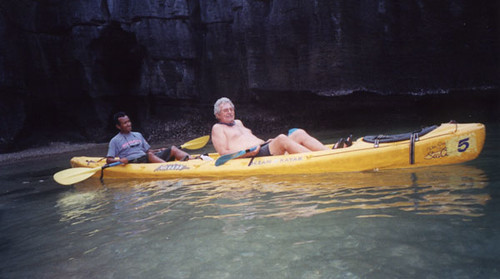
My first real adventure trip in Thailand and my first such trip in a long time took place in February 2003. It was organised by Sea Canoe, based in Phuket. The trip, dubbed the Bucket of Bulldogs Tour, was with seven other guys and we all got on amazingly well, considering our different backgrounds and personalities.

After taking a 14-hour train ride from Bangkok down to Trang, and spending a day and night there in a hotel, the Sea Canoe people picked us up the next morning and took us on a two-hour drive by songtaew (pickup) to Talay Noi National Wildlife Sanctuary, just in time to see the lotus blossoms still open. The place was abundant with birdlife, with the best viewing close to shore. I was thus dismayed to find out that we would not be immediately paddling on arrival there. We would first be towed out to a more desireable spot by longtail boats. This would set the tone for the rest of the trip: A lot of riding around on various conveyances and then a little bit of paddling.

When we finally got around to paddling, it was nice, and we probably would have seen and heard a lot of birds if it hadn't been for the constant drone of longtail motor boats ferrying package tourists around (and this was after we had been advised to keep quiet, though one of our party used the lull between between longtail boats to discuss the differences of Southern Thai language and Central Thai language).

I saw some kind of falcon catch a fish and carry it away. Also, there were numorous comorants and gulls as well as some Brahminy kites. It was pointed out by one of our more astute members that these birds were migratory and would be spending their nesting season in Siberia or some far-off place.

Later in the day, we took a short, rugged nature hike and went in a cave with bats, blind fish and some centipedes. I can't remember the name of the park we visited. We got our first whiff of bat dung, which we would smell several other times during the trip. We stayed in Phatthalung at a fish farm that had some cheesy guest bungalows. The carpeting on the walls was the touch of class that woudn't be out of place at a summer cabin up on Lake Superior.

I was feeling sick and we stopped at pharmacy. I self-medicated myself with amoxicillin. Also, my roomie for the night gave me a does of Theraflu. In return, I gave him my cold and felt better the next day.


Day three started with a dusty truck ride and a long hike to see the Sakai hilltribe people. They are an ancient people who have been in Thailand probably longer than any other people. A secretive tribe, they were scared of us. Only an old man, the village chieftan, was present when we arrived. Then a middle-aged woman came out. Gradually, more women and children came out, probably about two dozen people in all. There were no adult males in the village, except for the old man, who demonstrated his skill with the blow gun, an artefact he would later give to one of our party. Many of the children were clearly half Thai, with straighter hair and lighter skin - the result of Thai-Malay rubber tappers having relations with Sakai women. After a lunch, just outside the village, we headed back down the mountain. I was walking ahead of the party, searching for some solitude away from the banter of the others when I came upon the young Sakai men. It was pretty scary, being alone in the woods and meeting up with some boys from the 'hood. But, there were just as scared of me, I suppose, and were wondering what a little, fat white man was doing out in their jungle.

On the way to Pakbara pier, we had 20 minutes to swim at a raging waterfall and wash the dust off. At Pakbara, we each got a rustic bungalow. At sunset, three of us went for a sunset paddle. We were taken out into the bay by longtail boat, where we paddled around Koh Yai. I saw a white-bellied sea eagle, a small cave with bats and some crab-eating macaques. Later at night I borrowed a bicycle to search for an Internet cafe and get some change for a 1,000 baht bill. I found out why Thai people ride their bicycles so slow - none of them have brakes that work. I discovered this without mishap and adjusted my speed accordingly.
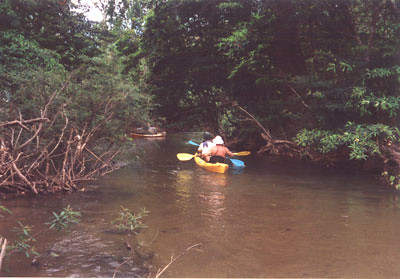

The next morning we were taken to the Satun River for a paddle through Seven Curves Cave - a real cave with bats and darkness. First, we paddled upstream in the dark, in a cave, a wholly disorientating experience. You couldn't see the current, so it would come out of nowhere and threaten to sweep you into a wall. Had we been prepared for this with proper headlamps and helmets, it wouldn't have been as big a deal. We paddled up through the cave and then turned around and paddled downstream through it, followed about about an hour's worth of paddling on a river - a wholly relaxing experience not unlike float trips I had been on back in the States. After the paddle, we stopped at an interesting set of waterfalls that went over some clay. The surface was kind of soft and tactile, not slippery, so it was fun to climb up the falls.

That afternoon, we headed back to Pakbara and hooked up with the small boat that would take us out into the Andaman Sea. Our first stop was Koh Tarutao National Marine Park, a two- or three-hour trip. The sea was pretty choppy, and I got slammed by a good-sized wave. Also, some of the kayaks came undone went flying off the top of the boat.

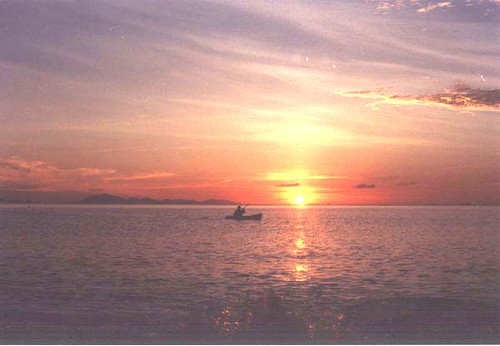
On Tarutao, after getting situated in a quirky bungalow, there was time for another sunset paddle. We did a fairly good pull, this time paddling from the harbor to a couple of beaches, all without the assistance of any motorised craft. That was pretty nice.

The bungalows on Koh Tarutao left a bit to be desired. They are tidy, sturdy and clean, but there's no fans in the room, so it's hot at night. Also, there's no power during the day, which is not a problem unless you use the toilet, which is windowless.

Tarutao is a historic place, as we learned from the excellent visitor's center (with an interesting library). There was once a penal colony on the island, with some influential political prisoners. During World War II, when the island was cut off, the prisoners and the officers became pirates and conducted raids throughout the strait. The island was the setting for "Survivor: Thailand", the US unreality TV show. I saw no evidence of the TV show having been there, though.

Day 2 on Tarutao was spent paddling up through some mangroves. This would prove to be the most challenging activity on our trip. We paddled up the river that runs through the center of the island. It is lined with mangrove swamps and we saw some crab-eating macaques along the way.
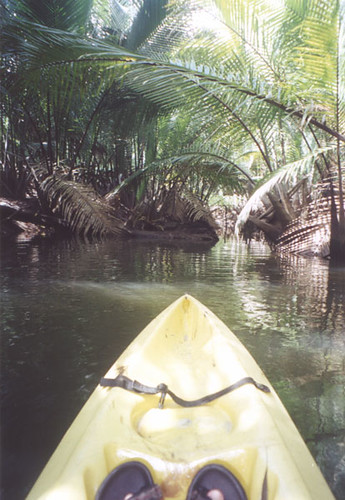
When we got to the cave, we had to portage into it. During these manuevers (the Sea Canoe people did most of the lifting and carrying) I lost a flashlight, but had a spare.
We paddled through the cave (fairly disorientating, but not as bad as being on a fast flowing river) and then up a creek that got smaller and smaller until we couldn't paddle anymore. We then turned around. When I got back to the mouth of the cave, the water had gotten lower and the entrance was sealed. There was still a way in, but not by boat. It was necessary to get out of the boat and drag it through the mud. I got out and sank in up to my knees. I stayed calm and got out, but not without having my Teva sandals sucked off. I retrieved them, but they were broken.

The rest of the group was similarly baffled by the problem. One of the Sea Canoe guides tried unsuccessfully to find a new way into the cave. From inside the cave, I advised all to take off their sandals and go the way I did. Eventually, we all got through, but not without getting muddy.

The next day, we departed Tarutao for an island I will not name because it's a nice place and I don't want to see it trashed. The beach was clean, and there was a coral reef right off the shore, where I went for my first-ever snorkeling swim. I saw all kinds of fish and colorful coral.

Later, I took a hike up a mountain, which turned out to be quite exhausting. Another part of my sandals broke, which I was able to repair, with the help of a loaned Swiss Army knife and the encouragement of at least one other person. I also took a short sunset paddle. The accomodation was some neat tent bungalows, which I shared with one other person. This was a relaxing place.

The next day, we headed out to Koh Rawi for snorkeling. At some point, the Sea Canoe guys thought it would be a good idea to try some snorkeling. I jumped into the ocean, only to see black murk in choppy waters and to feel the sting of jellyfish. Bad idea. Later, at Koh Rawi, I snorkeled and saw fish and coral to my heart's content. It was pretty nice.

This was also our last time of kayaking, a 30-minute slog through choppy seas and baking sun from Koh Rawi to another small island. It was an inauspcious end to the "kayak" trip that didn't see us do an awful lot of paddling.

The last night of the adventure was spent of Koh Lipe, an island of resorts with lots going on. Budget travellers visit here use it as a base to explore other islands. This particular night, a big man named Jimmy, representing probably 300 pounds of heavenly joy, was having a wedding party after marrying his Thai girlfriend. There was lots of people dancing on the beach in what must have been a full moon party.

Our final day was spent travelling, first by boat back to Pakbara, then minivan (my least favorite mode of travel in Thailand) and finally by airplane from Hat Yai back to Bangkok.

Overall, I will give the Sea Canoe people high marks for planning a gradually more challenging itinerary for us out-of-shape guys, as well as their helpfulness and courtesy, especially at mealtimes, where the group of us were all served at the same time, personally being waited on by the Sea Canoe staff. The difficulties in this trip were perhaps unavoidable, and without them, it wouldn't have been as memorable or as adventurous an experience.
Thursday, January 3, 2008

Amphawa Now


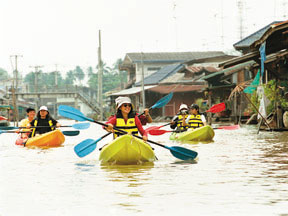
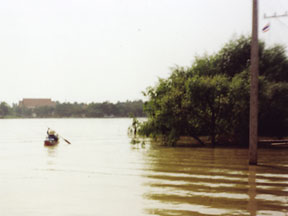
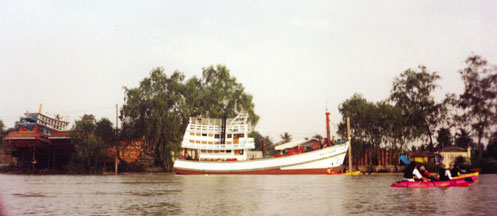
A group of Thai journalists took a tour of the village of Amphawa, Samut Songkhram Province, Thailand on November 12, 2002. The trip was sponsored by Joy Sports, a local provider of Feel Free kayaks, and Baan Tai Had Resort. The then-new resort gave tourists a mission: Paddle a kayak through the canals of the village and be drawn toward the charms of its people, their history and their way of life on the Mae Klong River. Here is the story I brought back from the trip:

"Never get out of the boat." Wiser words, from the character "Chef" in Apocalypse Now, have perhaps never been uttered in movie history.

They certainly hold true in Amphawa where a new resort, Baan Tai Had, situated on the Mae Klong River, is promoting the eco-friendly sport of kayaking as a way for tourists to get into the stream of life in the sleepy Samut Songkhram province village.

The river is a metaphor for life's journey in Apocalypse Now. In the Vietnam war film, Chef and Martin Sheen's character take a walk into the jungle, leaving the Navy patrol boat that is ferrying them to Cambodia on a mission. Chef wants some mangoes, but gets more than he bargained for when a tiger chases them back out of the greenery.

There are no tigers in Amphawa. But then, there is no real reason to get out of your boat either as in this town, the river is life.

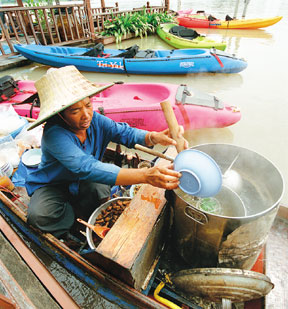
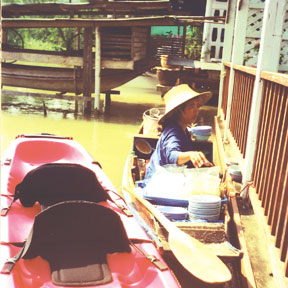
Everything is available on the water. If you want some noodles, there will likely be a noodle vendor in a boat, paddling her way down the canal, just when you are getting hungry. How about some ice cream? The ice-cream man drives a boat, too. Fresh vegetables? The water-borne hawker will be right along.

Or, you can tie up along the footpath at a shop and have what you want brought out to you.

Of course, there's no reason why you can't get out of your boat, since no tiger is likely to jump out at you.


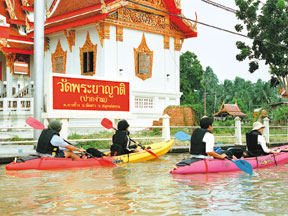
In fact, there are plenty of reasons to get out of the boat, such as the preserved remains of the "miracle monk" at Wat Juramanee. The monk, Nung, was a much revered figure in the province, and when he died about 15 years ago, his body was placed in a glass casket and left to lie in state inside the wat's huge temple, the interior of which is painted in gold-leaf detailing.

If you stay in your boat, you'll never see the exquisite frescos in the temple at Wat Amphawa. The reconstructed paintings run from floor to ceiling and picture in great detail the goings on around the court of King Rama II, who was born in Amphawa. His history permeates the province and a great many of the numerous temples there go back to his time. Wat Amphawa is on the grounds of King Rama II Botanical Garden, which includes a museum set up in an old-style wooden house.

At least one temple in the province, Wat Ban Kung, goes back a bit further, to the Ayutthaya period. This was where King Thonburi brought his court to regroup after the fall of the old capital, before he came to Bangkok to establish a new capital. You have to go by road to see this one. It's a small temple that is made quite impressive by the huge, 300-year-old banyan tree that has spread its serpentine limbs up and over the structure, making it look like the temple was built inside the tree.

At another temple, Wat Bang Kai Noi, work has been going on for the past 10 years to install elaborately wood-carved illustrations of stories from Buddhist scripture. It's quite a sight to behold, and not far from the river. Thing is, you have to get out of your boat to see them.

Of course, if you stay in your boat, you'll get to see the way of life in the town. You'll get a feeling that you are travelling back in time, as the old-style wooden buildings line the banks of the canal. It's quite a change from the concrete and steel structures that have taken over the landscape elsewhere in the Kingdom.

You'll see bemused expressions on the faces of residents as they watch you paddle past in your gaily coloured kayak. Or, because you are paddling silently along, without the noisy power of a long-tailed boat engine, you might scare a grandmother who is taking a bath in the river, and get to see her scurry away to cover before you get too close.

There's wildlife of the animal kind as well. Herons pass overhead, diving into the river for some fish. Emerald green flycatcher birds perch on the utility wires over the canal. They dive to the surface of the water, snatch up bugs and carry them back to the wire, where they beat the insects into submission with a few audible thwacks of their beaks on the cable.

The klongs in Amphawa are still very much active. Not having been blocked off and left to stagnate, the water is clean.

In late October and early November, a night-time boat trip on the Mae Klong comes with a light show, as fireflies are swarming in the trees and shrubbery along the shore. It's an unbelievable sight at first, as entire trees are aglow with flashing, yellow pinpoints of light. At first you might think someone has strung Christmas lights up in the trees, but there are so many it wouldn't be possible.

Tourism is still in its infancy in this province - a place where visitors pass through on their way to somewhere else. With the opening of Baan Tai Had Resort at the end of month, perhaps some tourists will find a reason to stop. Even then, the sights are more geared for Thai tourists, as little English is spoken and practically no literature is available in anything but Thai. But once the Thai tourists come, others will follow. And maybe they'll get off the boat.


The noodle lady of Amphawa

Floating markets are popular tourist draws in Thailand. There are a lot of very colorful pictures of them, with women in traditional Thai clothing - big straw hats and such - paddling small boats laden with produce, food and handicrafts. Some are said to be tourist contrivances, but I don't really know about that. They remain popular, that's for sure, and are one of the most common items on a lot of tourists' itineraries.

One of the more authentic floating markets is in Amphawa, on the Mae Klong River in Samut Songkhram Province, Thailand. I understand it is only held at a certain time of the month, in line with the lunar calendar, probably due to the tides on the ocean. I don't really know more than that, okay?

What I do know for sure is when I visited Amphawa in 2002, there was regular everyday trading going on from boats. Merchants were using boats to cart produce around. One guy was selling ice cream from his boat.

And I ate noodles from a noodle lady in a small boat. She cooked with propane but paddled her boat around, searching for hungry people and selling noodles. I don't remember how much the noodles cost, but they were cheap.

Wednesday, January 2, 2008

In Amphawa, canals are the fastest way to get around


This is a story I wrote after a trip for work in 2002.

With more than 300 canals criss-crossing Samut Songkhram Province and the Mae Klong River, there are plenty of opportunities for boating.

Now, Baan Tai Had Resort promotes kayaking as a way of seeing the province.

"The way of life of the people of province depends on the river," says Patcharodom Unsuwan, the resort's managing director.

But rather than loading tour groups up in noisy, diesel-powered long-tail boats, Patcharodom wants visitors to get into a small boat and use a paddle to get around in the vast network of canals, known in Thai language as klongs (or khlongs).

A map of the klongs is in the works, he says. Until then, about the only hazard kayakers might face will be getting lost.

For those who know the way around, a trip from the resort to the centre of Amphawa takes only 15 minutes by non-motorised boat, via the canals. It's a distance of about 3.5 kilometres, compared to 5km by the river, or 10km by the narrow, winding, bumpy system of roads.

The type of kayaking that is being promoted is different from whitewater sport being undertaken by daredevils in Nakhon Nayok and other extreme places. About the only thing the two activities have in common is the two-bladed paddle.

In Samut Songkhram, it's an easy-going, leisurely activity. The kayaks themselves are easy to use and require no special techniques, such as the eskimo roll. In fact, the boats are quite stable and there's likely no chance of them tipping over. The current in the Mae Klong River and the klongs of Amphawa is negligible and easy to navigate. There are no rocks or rapids.

About the only obstruction would be the palm nuts bobbing on the water's surface. Tourism may not be a major revenue source in Samut Songkhram, but palm tree plantations and catching fish and giant, succulent shrimp from the Mae Klong River are livelihoods for many residents.

Baan Tai Had Resort is on the outskirts of Amphawa town. As of 2002, rates were Bt800 Sunday through Thursday. On Friday and Saturday, the rate is Bt940, a price that includes breakfast.

The resort has five kayaks available. Rental prices have yet to be set. Boat tours, a firefly-viewing dinner cruise and van trips to historical sites can be arranged. There are authentic floating markets in the province. The days they are held depend on the lunar cycle.
Comment: Do a Google search for "Baan Tai Had Resort" and you'll likely get any number of hotel-booking websites. Take your pick. Or, try to contact the resort direct.

Battambang fisherman

Sometime in 1999, I took a trip through northwestern Cambodia and stayed for a few days around Battambang, seeing the sights. I hired a motorcycle taxi driver to take me around. One of the places he showed me was a reservoir. The dam was built by hand by prisoners doing forced labor under the Khmer Rouge.

Mekong River sunset paddle

Sometime in the year 2000 I visited Kratie, on the Mekong River in Cambodia. The main attraction of Kratie is a small, endangered pod of Mekong dolphins (or Irrawaddy dolphins). There are boatmen at this spot on the river, which is strewn with rocks. At the time of my visit, the boatmen would paddle you out in their small boats to view the dolphins for about one hour. They charged $1.

The best times to visit were early in the morning and just before dusk. I went at sunset. I did see some dolphins, but they were difficult to photograph.

Welcome to Kayaking in Thailand

Canoeing was a favorite activity when I was living in the United States. Now, living and working in Thailand, it's harder to get out of the office and do some paddling. Still, I've managed to get out on a few trips.