Showing posts with label fireflies. Show all posts

Saturday, January 12, 2008

Celebrate Loy Krathong every day on Pang-nga Bay


Though Thailand's Loy Krathong festival is only held during the full moon in November, there's a way to celebrate the water-borne rite anytime. With John Gray's Sea Canoe, visitors to the caves in Pang Nga Bay set their Loy Krathong boats afloat each night of the year.

To celebrate Loy Krathong, adherents launch small round boats, or krathongs, decorated with banana leaves and flowers. They pray for sins of the previous year to be washed away and for good luck in the next year. Even more traditionally, they pray to the water spirits, asking for forgiveness for any harm that was caused to water during the year. Additionally, absolution is asked for any acts that might harm water during the course of the next year.

It's as if Gray, a sincere environmentalist, is working to help the whole world, or at least a small corner of it, be granted forgiveness for polluting and wasting a precious natural resource.

He's helping in other ways, too.

"It's become a sweetheart thing, too," Gray told a group of around 20 people who took his Hong by Starlight tour on November 27, 2004. He explained that couples often launch their krathongs together, hoping for a good relationship for the next year. "So you married couples, you'll never fight again," Gray said to the laughter of the group.

The trip coincidentally took place one day after the traditional Loy Krathong, and an almost full moon was on the rise after a day of touring through four caves or hongs, Thai for room. But there was one last stop – the floating of krathongs. Some on the tour had floated krathongs the night before, so they were in for an extra helping of absolvement and good fortune.

With the help of their guides, everyone made a krathong to float, with a cutting of a banana log, banana leaves, joss sticks, candles and flowers supplied. Surprisingly, there were a few Thais who had to be instructed in the art of krathong making as well.


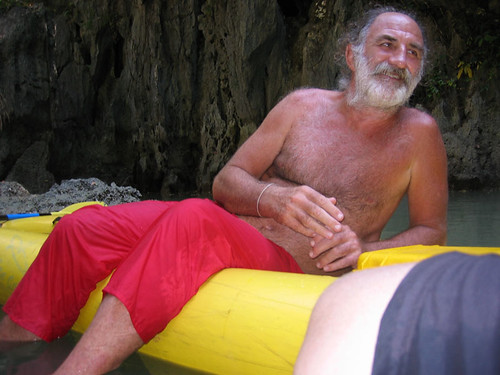
A pony-tailed 59-year-old former surfer and rugby player with a background that ranges from epidemiology to documentary filmmaking, Gray began the night-time canoe tours around 2001.

He's been Thailand since 1989. He came here after spending time in Hawaii, where he started a sea-canoe touring business and helped lobby for laws to protect the environment.

"Then I thought I'd move to Asia and try to change things," he said to the knowing laughter of my friend and I as we rode in the van to his pier from our guesthouse. He’d picked us up that morning.

He started a sea-canoe business in Phuket and hoped to spread franchises throughout the island, providing environmentally responsible business opportunities to the locals. Instead, more than a dozen crass imitators were spawned, all operating on his turf in Pang-nga Bay. So many operators were offering day trips, he decided to switch to after-dark operations.


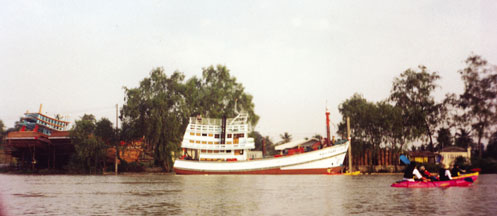
His Hong by Starlight actually begins during the day, and it was 10:20am when Gray fetched the writers from their hotel. The times the trips start vary, depending on the tides.

By around 12:30pm, Gray's 15-metre, diesel-powered trawler had made its way from the pier to the inaugural paddle of the day. Along the way, the guests ate a lunch of spring rolls, fried noodles, green salad and chilled fruit. Always looking to spread his environmental views, Gray noted that no shrimp would be found on his menu, because shrimp farms destroy mangroves.

Gray lectured about how the odd-shaped limestone formations, or karst, came into being over the course of millions of years. He talked about the delicate environment of the mangrove lagoons within the karst hongs, and urged his tour group to be respectful.

Keeping quiet was strongly urged, as Gray showed a drawing of a person with a zipped lip. Soft talking among the guides and their passengers was okay, but "if they can hear you talking in the next boat, you're talking too loud", Gray said.
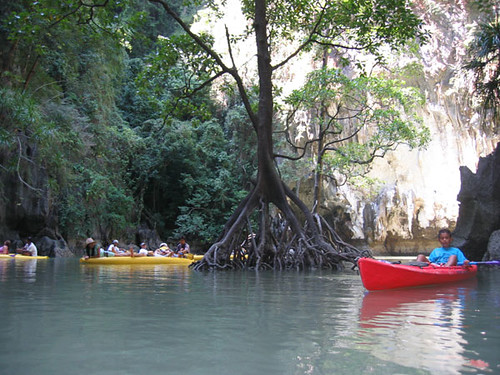


The group was split into pairs and given a guide – a canoe paddler. Slip-resistant steps made it easy to get from the escort boat into the specially made canoes – long, narrow boats big and stable enough to comfortably hold three people. The canoes are made of heavy, rubberised fabric, similar to the construction of river rafts. To make them even more of a hybrid, they are powered by the double-bladed paddle used for kayaks.

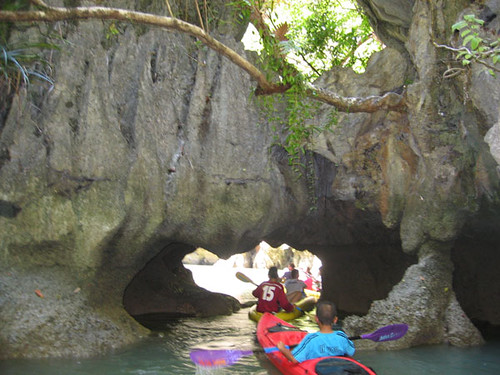
The first stop was Princess Cave, named for Her Royal Highness Princess Maha Chakri Sirindhorn, who once toured the cave with Gray's company. It was a technically difficult start to the day, requiring the passengers of the canoes to lie flat on their backs as the low-slung boats slipped under low-hanging, oyster-encrusted rocks.

Gray had warned everyone to not touch the oyster rocks. Extremely sharp, they'll "cut through to the bone" if you press your hand against them. Navigating through this treacherous passage was a task best left to the guides, who needed no assistance to manoeuvre the canoes.

Through the cave, the way opened up to the sky and the group got its first taste of a mangrove hong, a water-filled lagoon surrounded by the hollowed out walls of the limestone rock. After about 20 minutes, they turned around and went back through the cave.
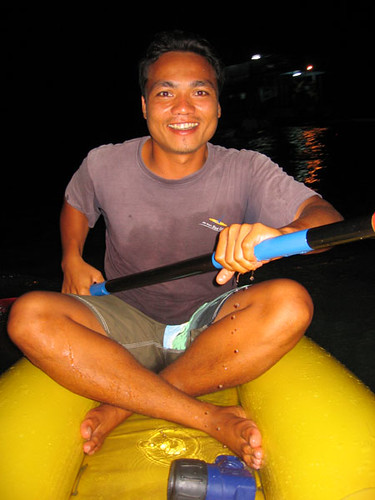
"Another 10 minutes, this will be empty," said Sompong "Pong" Hamvong, my guide.

Gray's tours are scheduled to take advantage of the tides. The water must be high enough to allow the boats easy passage, but not so high as to keep them from slipping under the low entrance of the caves.

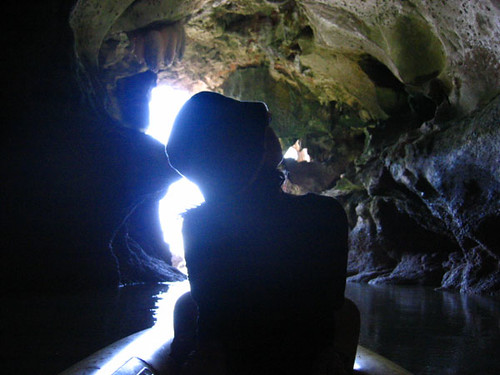
The next stop was Diamond Cave, so named for a sparkling stalactite formation inside it. Here is where Gray’s competition was encountered. At least two other tour groups were present and the inside of the cave resembled a theme-park ride, with dozens of rubber canoes passing to-and-fro in the dark.

The other tour groups hadn't been admonished to zip their lips, or if they had, the words had been ignored. One foreign tourist was oohing and aahing loudly as he looked around, and was unmindful of the angry stares and the "shhh's" directed his way. That group departed quickly, though, leaving Gray's group alone.

On the way out, Gray pointed out an overhanging branch, high up on the hong walls. There used to be a white-bellied sea eagle that sat there every day, he said, until too many noisy tour groups started coming to Diamond Cave.

Gray continues to try and do his part, though. During the day, he set out paddling solo in an ocean kayak, which he would fill with garbage found along the way. At least two loads of trash were picked up during his solitary voyages.

Next for the group was the Bat Cave, so named for its colony of insect bats. The theme-park scene was much the same here, but after five minutes Gray's group had the place to itself. The other companies were finished for the day. Gray’s had just begun.

In the Bat Cave hong, the group watched as the water receded, exposing the mud flats. Slowly, strange finned creatures emerged. They were mudskippers, fish that can operate on land for short periods of time.

"Say hello to your ancestors," Gray told the group. More and more of the mudskippers emerged, some fighting for their small piece of the muddy turf. Depending on the strength of your telephoto lens, they looked like cute, little bickering critters or fierce, prehistoric throwbacks, engaged in a battle to the death.

There was also fiddler crabs and at least one mangrove snake. After 20 minutes or so had passed, the group was paddling out of the hong, lest they become part of the muddy habitat themselves – at least until the tide rose again.

Other wildlife spotted during the day included crab-eating macaques, who were spied swinging from the trees high above the hong. There were also brahminy kites – white-headed eagle-like raptors. At least a dozen or so trailed behind the trawler as Gray's staff baited them with pieces of raw chicken that were thrown into the water.

The next-to-last stop was at Hong Island, a small bay where the group could engage in some "self-paddling", finally getting to try their hand at canoeing themselves, and exploring the surroundings, all under the watchful eye of Gray.

After a sumptuous feast of rich, filling brown rice, tempura-fried vegetables and fish, cashew chicken and other dishes, the boat returned to the Bat Cave.

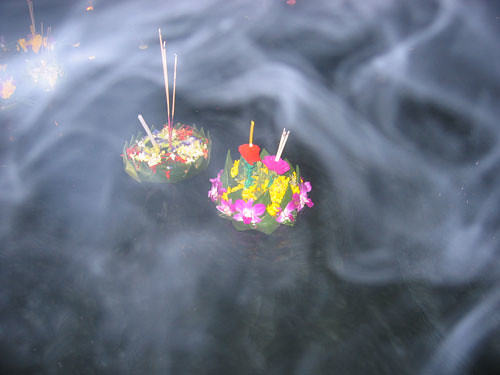
With the krathongs made along the way, the group headed back into the cave. Urged to be extra quiet inside the hong, the kratongs were set afire and put afloat.

Along with the glow of the kratongs, there were two forms of bioluminescents. In the air were fireflies, with their tails aglow in a mating ritual. And in the water were plankton that became luminescent when disturbed by the paddles or by the hands of the group members. It was if nature itself was joining in the loy krathong ceremony, working overtime to bless the participants and absolve them of any sins committed against the environment.

A good start toward that end was the retrieval of the krathongs, which some guests kept with them as a reminder of the message Gray shared with them.


The Hong by Starlight tour was Bt3,450 per person (November 2004) and included transport to and from hotel, meals, snacks and strong filtered coffee. A change of clothes is suggested, as participants will get wet. A changing room is available. Dry bags are provided for cameras and other items, but John Gray's Sea Canoe is not responsible if there is any loss or damage to such valuables.

John Gray's Sea Canoe
124 Soi 1 Yaowaraj Road
Talad Yai, Phuket
(076) 254 505-7
www.johngray-seacanoe.com

Comment: On December 26, 2004, one month after my trip with John Gray's Sea Canoe, a tsunami struck Phuket and the Indian Ocean region, causing more than 120,000 deaths. John Gray was among the survivors, though. Please read his account of that fateful morning.

Monday, January 7, 2008

Kayaking at Koh Kood


Along with swimming gear and sunblock, make sure you bring a hearty appetite for seafood if you stay at Klong Chao Resort on Koh Kood (or Koot or Kut).

Like all the resorts on this remote island in the Koh Chang archipeligo in the Gulf of Thailand off Trat Provice, Klong Chao operates a package deal. For a trip I took with a friend in March 2004, the deal I chose was a three-day, two-night package for 3,800 baht per person. For that price, we were picked up at the bus station in Trat, taken to the island by speedboat, put up in a cozy bungalow, fed sumptuous meals and taken snorkeling and sightseeing.

Klong Chao is situated on a small creek of the same name. Other resorts along this stretch at the time included Koh Kood Shambala, Klong Chao Beach Resort and Peter Pan.

My reason for choosing this resort was because I could find English-language information about it, which said the place had kayaks available. So along with getting in some snorkeling, I could satisfy my kayaking jones. It's ironic that the resort was featured on an English-language website, as none of the staff speak much English, except for Arthit, his brother, Sukree (whose name appears on the business cards) and a third brother whose name I didn't catch.

The boats available were the ubiquitous Tri-Yaks by Feelfree. They were a little beat up, with the straps for the backrests torn off. Presumably, the backrests had been used as handles in hoisting the boats down from the dock. Or, the backrests have simply been used as buttpads and been worn out. While I was staying there, one of the co-owners, Arthit, received three more new Tri-Yaks and was unpacking them one morning. I wonder how long the new ones will be in use before they start showing signs of wear?

The resorts are mainly geared to handle large numbers of Thai tourists. Indeed, the reason Arthit was unpacking three new kayaks was because he was expecting a group of 80 Thai holidaymakers, arriving the next day to celebrate the long weekend and the Makka Bucha Buddhist holiday.

The kayaks are fine for just lazing around on holiday and paddling short distances. I wouldn't recommend them for long trips. They are great for casual paddlers, as they are easy to board and are extremely stable. Although they are a one- or two-person kayak, it's not uncommon to see three Thai holidaymakers piled aboard, happily paddling away, but not really getting anywhere.


A speedboat tour and snorkeling tour of the nearby islands opened my eyes to the possibilities of kayak touring around the area. I guess it would be possible for seasoned ocean kayakers with good equipment to outfit themselves and spend a week or more exploring the waters, islands and coral reefs around Koh Chang, Koh Mak and Koh Kood. GPS navigation, maps and compass would be necessary, I would think, as well as fishing gear and/or groceries, a camp stove, tent and snorkeling gear.

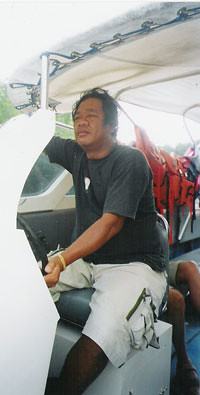
The speedboat driver was a guy named Lek, who in the grand tradition of Thais with nicknames looks the opposite of his name, which means small. Actually a beefy guy, Lek is not only an expert speedboat driver and navigator of the local waters, he's a tireless snorkeler. At one point during our day, he stopped to dive for clams, taking 30 minutes or so to fill three bushel baskets full to fill our plates at the evening meal. Again and again, he dove to the bottom to pick up more clams. And this was after two snorkeling jaunts earlier with the tour group. He also unloaded a trap, hauling aboard a single squid which he left on the deck of the boat to dry out and change colors before our very eyes. Presumably, it was served up for the evening meal as well.

Another thing about Lek: He never shuts up. But I mean this with all possible kindness. All day long, Lek chattered away good naturedly. He even talked through his snorkeling tube!

Lek's clams were the highlight of the second night's meal. The first night, there was plate after plate of crab. Darn, why didn't I take my camera to dinner? Co-owner Arthit boasted that other resorts charge extra if you ask for a second plate of crab. He supplies them free.

The only thing that costs extra is if the guests want alcoholic beverages beyond the single Spy wine cooler (split between two guests and poured in a classy wine glass) and a blue vodka and crush-ice cocktail provided at the first night's meal. I drank some non-alcoholic lemon shakes, provided free as part of the all-you-can-eat, all-you-drink (coffee, water, sodas) package.

Aside from snorkeling, big meals and time for early evening kayaking, the resort's other activities included a trip upstream to a waterfall. It was just a trickle at the time of year I visited, but there was a refreshing pool to swim in. One evening, a long-tail boat was pressed into use for a trip upstream to view the fireflies. Sparse at first, more and more were revealed in the treetops, until it looked like Christmas. They were still hard to see because it was nearly full moon.

A fun activity would have been a moonlight kayak paddle, or early morning paddle, but I was taking it easy this time out.

I was tipped off to Koh Kood by a friend who stayed at a new resort there on a part of the island that had no phone, no lights and no motorcars. So I was dismayed to find phone service, 24-hour electricity and roads on the part of the island I visited. There were also karaoke machines, stereos and cable televisions, making for a less-than-quiet holiday at times. But with the kayaking, the snorkeling and the food, everything evened out.

Note: Klong Chao Resort can be contacted through any number of hotel booking firms. Do a search on Google and take your pick, or try to contact the resort direct.

Thursday, January 3, 2008

Amphawa Now


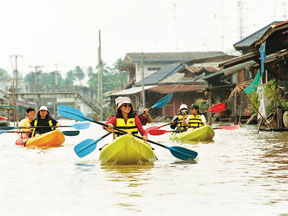
A group of Thai journalists took a tour of the village of Amphawa, Samut Songkhram Province, Thailand on November 12, 2002. The trip was sponsored by Joy Sports, a local provider of Feel Free kayaks, and Baan Tai Had Resort. The then-new resort gave tourists a mission: Paddle a kayak through the canals of the village and be drawn toward the charms of its people, their history and their way of life on the Mae Klong River. Here is the story I brought back from the trip:

"Never get out of the boat." Wiser words, from the character "Chef" in Apocalypse Now, have perhaps never been uttered in movie history.

They certainly hold true in Amphawa where a new resort, Baan Tai Had, situated on the Mae Klong River, is promoting the eco-friendly sport of kayaking as a way for tourists to get into the stream of life in the sleepy Samut Songkhram province village.

The river is a metaphor for life's journey in Apocalypse Now. In the Vietnam war film, Chef and Martin Sheen's character take a walk into the jungle, leaving the Navy patrol boat that is ferrying them to Cambodia on a mission. Chef wants some mangoes, but gets more than he bargained for when a tiger chases them back out of the greenery.

There are no tigers in Amphawa. But then, there is no real reason to get out of your boat either as in this town, the river is life.

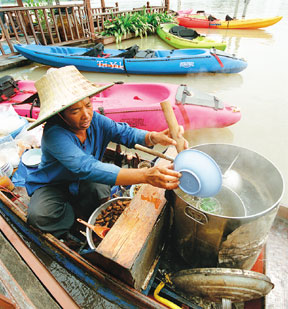
Everything is available on the water. If you want some noodles, there will likely be a noodle vendor in a boat, paddling her way down the canal, just when you are getting hungry. How about some ice cream? The ice-cream man drives a boat, too. Fresh vegetables? The water-borne hawker will be right along.

Or, you can tie up along the footpath at a shop and have what you want brought out to you.

Of course, there's no reason why you can't get out of your boat, since no tiger is likely to jump out at you.


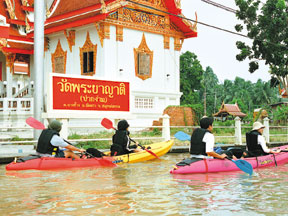
In fact, there are plenty of reasons to get out of the boat, such as the preserved remains of the "miracle monk" at Wat Juramanee. The monk, Nung, was a much revered figure in the province, and when he died about 15 years ago, his body was placed in a glass casket and left to lie in state inside the wat's huge temple, the interior of which is painted in gold-leaf detailing.

If you stay in your boat, you'll never see the exquisite frescos in the temple at Wat Amphawa. The reconstructed paintings run from floor to ceiling and picture in great detail the goings on around the court of King Rama II, who was born in Amphawa. His history permeates the province and a great many of the numerous temples there go back to his time. Wat Amphawa is on the grounds of King Rama II Botanical Garden, which includes a museum set up in an old-style wooden house.

At least one temple in the province, Wat Ban Kung, goes back a bit further, to the Ayutthaya period. This was where King Thonburi brought his court to regroup after the fall of the old capital, before he came to Bangkok to establish a new capital. You have to go by road to see this one. It's a small temple that is made quite impressive by the huge, 300-year-old banyan tree that has spread its serpentine limbs up and over the structure, making it look like the temple was built inside the tree.

At another temple, Wat Bang Kai Noi, work has been going on for the past 10 years to install elaborately wood-carved illustrations of stories from Buddhist scripture. It's quite a sight to behold, and not far from the river. Thing is, you have to get out of your boat to see them.

Of course, if you stay in your boat, you'll get to see the way of life in the town. You'll get a feeling that you are travelling back in time, as the old-style wooden buildings line the banks of the canal. It's quite a change from the concrete and steel structures that have taken over the landscape elsewhere in the Kingdom.

You'll see bemused expressions on the faces of residents as they watch you paddle past in your gaily coloured kayak. Or, because you are paddling silently along, without the noisy power of a long-tailed boat engine, you might scare a grandmother who is taking a bath in the river, and get to see her scurry away to cover before you get too close.

There's wildlife of the animal kind as well. Herons pass overhead, diving into the river for some fish. Emerald green flycatcher birds perch on the utility wires over the canal. They dive to the surface of the water, snatch up bugs and carry them back to the wire, where they beat the insects into submission with a few audible thwacks of their beaks on the cable.

The klongs in Amphawa are still very much active. Not having been blocked off and left to stagnate, the water is clean.

In late October and early November, a night-time boat trip on the Mae Klong comes with a light show, as fireflies are swarming in the trees and shrubbery along the shore. It's an unbelievable sight at first, as entire trees are aglow with flashing, yellow pinpoints of light. At first you might think someone has strung Christmas lights up in the trees, but there are so many it wouldn't be possible.

Tourism is still in its infancy in this province - a place where visitors pass through on their way to somewhere else. With the opening of Baan Tai Had Resort at the end of month, perhaps some tourists will find a reason to stop. Even then, the sights are more geared for Thai tourists, as little English is spoken and practically no literature is available in anything but Thai. But once the Thai tourists come, others will follow. And maybe they'll get off the boat.


Wednesday, January 2, 2008

In Amphawa, canals are the fastest way to get around


This is a story I wrote after a trip for work in 2002.

With more than 300 canals criss-crossing Samut Songkhram Province and the Mae Klong River, there are plenty of opportunities for boating.

Now, Baan Tai Had Resort promotes kayaking as a way of seeing the province.

"The way of life of the people of province depends on the river," says Patcharodom Unsuwan, the resort's managing director.

But rather than loading tour groups up in noisy, diesel-powered long-tail boats, Patcharodom wants visitors to get into a small boat and use a paddle to get around in the vast network of canals, known in Thai language as klongs (or khlongs).

A map of the klongs is in the works, he says. Until then, about the only hazard kayakers might face will be getting lost.

For those who know the way around, a trip from the resort to the centre of Amphawa takes only 15 minutes by non-motorised boat, via the canals. It's a distance of about 3.5 kilometres, compared to 5km by the river, or 10km by the narrow, winding, bumpy system of roads.

The type of kayaking that is being promoted is different from whitewater sport being undertaken by daredevils in Nakhon Nayok and other extreme places. About the only thing the two activities have in common is the two-bladed paddle.

In Samut Songkhram, it's an easy-going, leisurely activity. The kayaks themselves are easy to use and require no special techniques, such as the eskimo roll. In fact, the boats are quite stable and there's likely no chance of them tipping over. The current in the Mae Klong River and the klongs of Amphawa is negligible and easy to navigate. There are no rocks or rapids.

About the only obstruction would be the palm nuts bobbing on the water's surface. Tourism may not be a major revenue source in Samut Songkhram, but palm tree plantations and catching fish and giant, succulent shrimp from the Mae Klong River are livelihoods for many residents.

Baan Tai Had Resort is on the outskirts of Amphawa town. As of 2002, rates were Bt800 Sunday through Thursday. On Friday and Saturday, the rate is Bt940, a price that includes breakfast.

The resort has five kayaks available. Rental prices have yet to be set. Boat tours, a firefly-viewing dinner cruise and van trips to historical sites can be arranged. There are authentic floating markets in the province. The days they are held depend on the lunar cycle.
Comment: Do a Google search for "Baan Tai Had Resort" and you'll likely get any number of hotel-booking websites. Take your pick. Or, try to contact the resort direct.