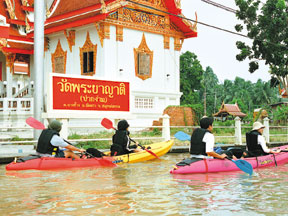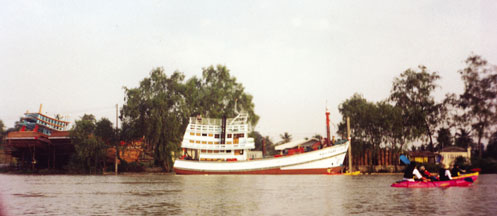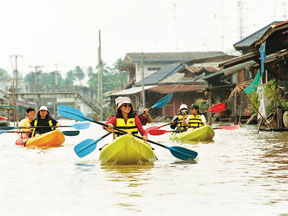
A group of Thai journalists took a tour of the village of Amphawa, Samut Songkhram Province, Thailand on November 12, 2002. The trip was sponsored by Joy Sports, a local provider of Feel Free kayaks, and Baan Tai Had Resort. The then-new resort gave tourists a mission: Paddle a kayak through the canals of the village and be drawn toward the charms of its people, their history and their way of life on the Mae Klong River. Here is the story I brought back from the trip:
"Never get out of the boat." Wiser words, from the character "Chef" in Apocalypse Now, have perhaps never been uttered in movie history.
They certainly hold true in Amphawa where a new resort, Baan Tai Had, situated on the Mae Klong River, is promoting the eco-friendly sport of kayaking as a way for tourists to get into the stream of life in the sleepy Samut Songkhram province village.
The river is a metaphor for life's journey in Apocalypse Now. In the Vietnam war film, Chef and Martin Sheen's character take a walk into the jungle, leaving the Navy patrol boat that is ferrying them to Cambodia on a mission. Chef wants some mangoes, but gets more than he bargained for when a tiger chases them back out of the greenery.
There are no tigers in Amphawa. But then, there is no real reason to get out of your boat either as in this town, the river is life.
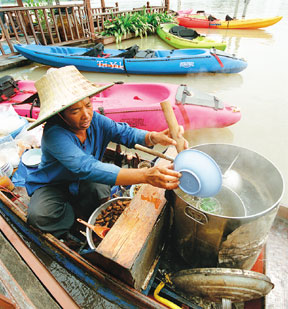
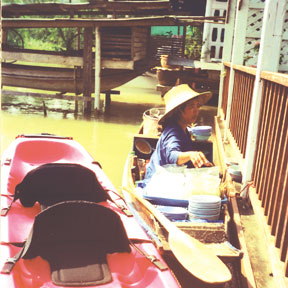
Everything is available on the water. If you want some noodles, there will likely be a noodle vendor in a boat, paddling her way down the canal, just when you are getting hungry. How about some ice cream? The ice-cream man drives a boat, too. Fresh vegetables? The water-borne hawker will be right along.
Or, you can tie up along the footpath at a shop and have what you want brought out to you.
Of course, there's no reason why you can't get out of your boat, since no tiger is likely to jump out at you.
In fact, there are plenty of reasons to get out of the boat, such as the preserved remains of the "miracle monk" at Wat Juramanee. The monk, Nung, was a much revered figure in the province, and when he died about 15 years ago, his body was placed in a glass casket and left to lie in state inside the wat's huge temple, the interior of which is painted in gold-leaf detailing.
If you stay in your boat, you'll never see the exquisite frescos in the temple at Wat Amphawa. The reconstructed paintings run from floor to ceiling and picture in great detail the goings on around the court of King Rama II, who was born in Amphawa. His history permeates the province and a great many of the numerous temples there go back to his time. Wat Amphawa is on the grounds of King Rama II Botanical Garden, which includes a museum set up in an old-style wooden house.
At least one temple in the province, Wat Ban Kung, goes back a bit further, to the Ayutthaya period. This was where King Thonburi brought his court to regroup after the fall of the old capital, before he came to Bangkok to establish a new capital. You have to go by road to see this one. It's a small temple that is made quite impressive by the huge, 300-year-old banyan tree that has spread its serpentine limbs up and over the structure, making it look like the temple was built inside the tree.
At another temple, Wat Bang Kai Noi, work has been going on for the past 10 years to install elaborately wood-carved illustrations of stories from Buddhist scripture. It's quite a sight to behold, and not far from the river. Thing is, you have to get out of your boat to see them.
Of course, if you stay in your boat, you'll get to see the way of life in the town. You'll get a feeling that you are travelling back in time, as the old-style wooden buildings line the banks of the canal. It's quite a change from the concrete and steel structures that have taken over the landscape elsewhere in the Kingdom.
You'll see bemused expressions on the faces of residents as they watch you paddle past in your gaily coloured kayak. Or, because you are paddling silently along, without the noisy power of a long-tailed boat engine, you might scare a grandmother who is taking a bath in the river, and get to see her scurry away to cover before you get too close.
There's wildlife of the animal kind as well. Herons pass overhead, diving into the river for some fish. Emerald green flycatcher birds perch on the utility wires over the canal. They dive to the surface of the water, snatch up bugs and carry them back to the wire, where they beat the insects into submission with a few audible thwacks of their beaks on the cable.
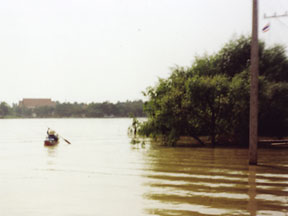
The klongs in Amphawa are still very much active. Not having been blocked off and left to stagnate, the water is clean.
In late October and early November, a night-time boat trip on the Mae Klong comes with a light show, as fireflies are swarming in the trees and shrubbery along the shore. It's an unbelievable sight at first, as entire trees are aglow with flashing, yellow pinpoints of light. At first you might think someone has strung Christmas lights up in the trees, but there are so many it wouldn't be possible.
Tourism is still in its infancy in this province - a place where visitors pass through on their way to somewhere else. With the opening of Baan Tai Had Resort at the end of month, perhaps some tourists will find a reason to stop. Even then, the sights are more geared for Thai tourists, as little English is spoken and practically no literature is available in anything but Thai. But once the Thai tourists come, others will follow. And maybe they'll get off the boat.