Though Thailand's Loy Krathong festival is only held during the full moon in November, there's a way to celebrate the water-borne rite anytime. With John Gray's Sea Canoe, visitors to the caves in Pang Nga Bay set their Loy Krathong boats afloat each night of the year.
To celebrate Loy Krathong, adherents launch small round boats, or krathongs, decorated with banana leaves and flowers. They pray for sins of the previous year to be washed away and for good luck in the next year. Even more traditionally, they pray to the water spirits, asking for forgiveness for any harm that was caused to water during the year. Additionally, absolution is asked for any acts that might harm water during the course of the next year.
It's as if Gray, a sincere environmentalist, is working to help the whole world, or at least a small corner of it, be granted forgiveness for polluting and wasting a precious natural resource.
He's helping in other ways, too.
"It's become a sweetheart thing, too," Gray told a group of around 20 people who took his Hong by Starlight tour on November 27, 2004. He explained that couples often launch their krathongs together, hoping for a good relationship for the next year. "So you married couples, you'll never fight again," Gray said to the laughter of the group.
The trip coincidentally took place one day after the traditional Loy Krathong, and an almost full moon was on the rise after a day of touring through four caves or hongs, Thai for room. But there was one last stop – the floating of krathongs. Some on the tour had floated krathongs the night before, so they were in for an extra helping of absolvement and good fortune.
With the help of their guides, everyone made a krathong to float, with a cutting of a banana log, banana leaves, joss sticks, candles and flowers supplied. Surprisingly, there were a few Thais who had to be instructed in the art of krathong making as well.
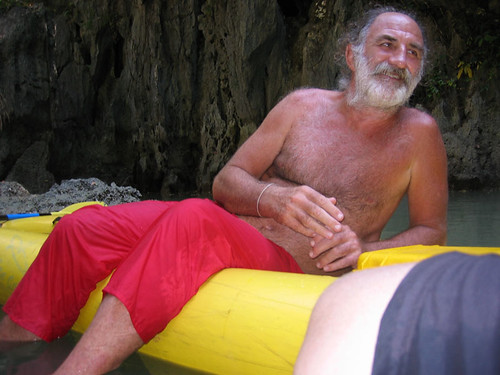
A pony-tailed 59-year-old former surfer and rugby player with a background that ranges from epidemiology to documentary filmmaking, Gray began the night-time canoe tours around 2001.
He's been Thailand since 1989. He came here after spending time in Hawaii, where he started a sea-canoe touring business and helped lobby for laws to protect the environment.
"Then I thought I'd move to Asia and try to change things," he said to the knowing laughter of my friend and I as we rode in the van to his pier from our guesthouse. He’d picked us up that morning.
He started a sea-canoe business in Phuket and hoped to spread franchises throughout the island, providing environmentally responsible business opportunities to the locals. Instead, more than a dozen crass imitators were spawned, all operating on his turf in Pang-nga Bay. So many operators were offering day trips, he decided to switch to after-dark operations.
His Hong by Starlight actually begins during the day, and it was 10:20am when Gray fetched the writers from their hotel. The times the trips start vary, depending on the tides.
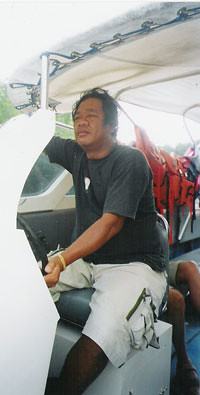
By around 12:30pm, Gray's 15-metre, diesel-powered trawler had made its way from the pier to the inaugural paddle of the day. Along the way, the guests ate a lunch of spring rolls, fried noodles, green salad and chilled fruit. Always looking to spread his environmental views, Gray noted that no shrimp would be found on his menu, because shrimp farms destroy mangroves.
Gray lectured about how the odd-shaped limestone formations, or karst, came into being over the course of millions of years. He talked about the delicate environment of the mangrove lagoons within the karst hongs, and urged his tour group to be respectful.
Keeping quiet was strongly urged, as Gray showed a drawing of a person with a zipped lip. Soft talking among the guides and their passengers was okay, but "if they can hear you talking in the next boat, you're talking too loud", Gray said.
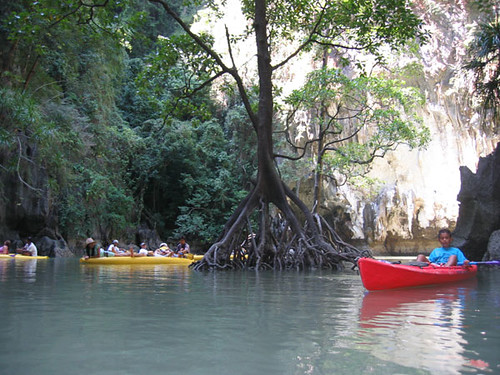
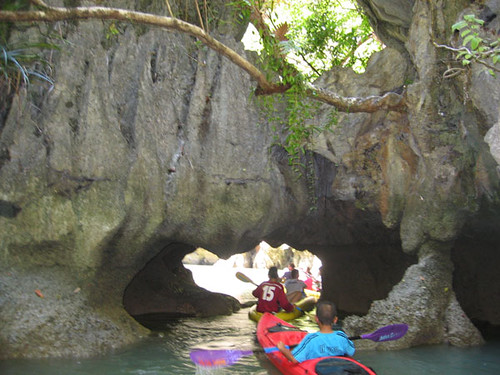
The group was split into pairs and given a guide – a canoe paddler. Slip-resistant steps made it easy to get from the escort boat into the specially made canoes – long, narrow boats big and stable enough to comfortably hold three people. The canoes are made of heavy, rubberised fabric, similar to the construction of river rafts. To make them even more of a hybrid, they are powered by the double-bladed paddle used for kayaks.
The first stop was Princess Cave, named for Her Royal Highness Princess Maha Chakri Sirindhorn, who once toured the cave with Gray's company. It was a technically difficult start to the day, requiring the passengers of the canoes to lie flat on their backs as the low-slung boats slipped under low-hanging, oyster-encrusted rocks.
Gray had warned everyone to not touch the oyster rocks. Extremely sharp, they'll "cut through to the bone" if you press your hand against them. Navigating through this treacherous passage was a task best left to the guides, who needed no assistance to manoeuvre the canoes.
Through the cave, the way opened up to the sky and the group got its first taste of a mangrove hong, a water-filled lagoon surrounded by the hollowed out walls of the limestone rock. After about 20 minutes, they turned around and went back through the cave.
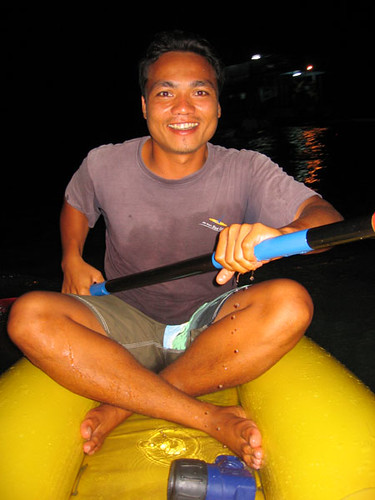 "Another 10 minutes, this will be empty," said Sompong "Pong" Hamvong, my guide.
Gray's tours are scheduled to take advantage of the tides. The water must be high enough to allow the boats easy passage, but not so high as to keep them from slipping under the low entrance of the caves.
The next stop was Diamond Cave, so named for a sparkling stalactite formation inside it. Here is where Gray’s competition was encountered. At least two other tour groups were present and the inside of the cave resembled a theme-park ride, with dozens of rubber canoes passing to-and-fro in the dark.
The other tour groups hadn't been admonished to zip their lips, or if they had, the words had been ignored. One foreign tourist was oohing and aahing loudly as he looked around, and was unmindful of the angry stares and the "shhh's" directed his way. That group departed quickly, though, leaving Gray's group alone.
On the way out, Gray pointed out an overhanging branch, high up on the hong walls. There used to be a white-bellied sea eagle that sat there every day, he said, until too many noisy tour groups started coming to Diamond Cave.
Gray continues to try and do his part, though. During the day, he set out paddling solo in an ocean kayak, which he would fill with garbage found along the way. At least two loads of trash were picked up during his solitary voyages.
Next for the group was the Bat Cave, so named for its colony of insect bats. The theme-park scene was much the same here, but after five minutes Gray's group had the place to itself. The other companies were finished for the day. Gray’s had just begun.
In the Bat Cave hong, the group watched as the water receded, exposing the mud flats. Slowly, strange finned creatures emerged. They were mudskippers, fish that can operate on land for short periods of time.
"Say hello to your ancestors," Gray told the group. More and more of the mudskippers emerged, some fighting for their small piece of the muddy turf. Depending on the strength of your telephoto lens, they looked like cute, little bickering critters or fierce, prehistoric throwbacks, engaged in a battle to the death.
There was also fiddler crabs and at least one mangrove snake. After 20 minutes or so had passed, the group was paddling out of the hong, lest they become part of the muddy habitat themselves – at least until the tide rose again.
Other wildlife spotted during the day included crab-eating macaques, who were spied swinging from the trees high above the hong. There were also brahminy kites – white-headed eagle-like raptors. At least a dozen or so trailed behind the trawler as Gray's staff baited them with pieces of raw chicken that were thrown into the water.
The next-to-last stop was at Hong Island, a small bay where the group could engage in some "self-paddling", finally getting to try their hand at canoeing themselves, and exploring the surroundings, all under the watchful eye of Gray.
After a sumptuous feast of rich, filling brown rice, tempura-fried vegetables and fish, cashew chicken and other dishes, the boat returned to the Bat Cave.
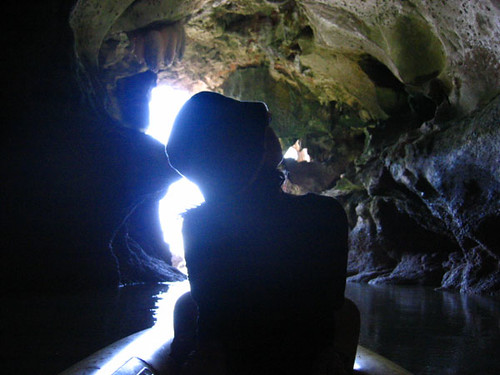
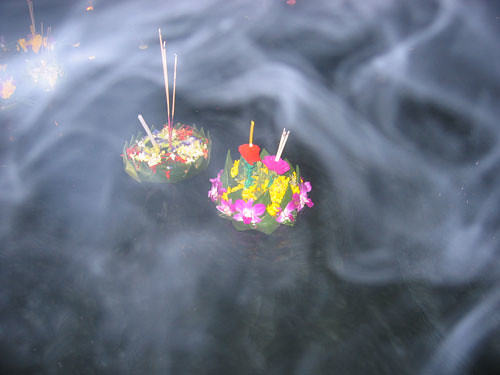
 With the krathongs made along the way, the group headed back into the cave. Urged to be extra quiet inside the hong, the kratongs were set afire and put afloat.
Along with the glow of the kratongs, there were two forms of bioluminescents. In the air were fireflies, with their tails aglow in a mating ritual. And in the water were plankton that became luminescent when disturbed by the paddles or by the hands of the group members. It was if nature itself was joining in the loy krathong ceremony, working overtime to bless the participants and absolve them of any sins committed against the environment.
A good start toward that end was the retrieval of the krathongs, which some guests kept with them as a reminder of the message Gray shared with them.
The Hong by Starlight tour was Bt3,450 per person (November 2004) and included transport to and from hotel, meals, snacks and strong filtered coffee. A change of clothes is suggested, as participants will get wet. A changing room is available. Dry bags are provided for cameras and other items, but John Gray's Sea Canoe is not responsible if there is any loss or damage to such valuables.
John Gray's Sea Canoe
124 Soi 1 Yaowaraj Road
Talad Yai, Phuket
(076) 254 505-7
www.johngray-seacanoe.com
Comment: On December 26, 2004, one month after my trip with John Gray's Sea Canoe, a tsunami struck Phuket and the Indian Ocean region, causing more than 120,000 deaths. John Gray was among the survivors, though. Please read his account of that fateful morning.