Showing posts with label resort. Show all posts

Saturday, January 12, 2008

The Big One: Tsunami strikes Phuket


On December 26, 2004, a tsunami hit Phuket, Thailand and the Indian Ocean region. More than 120,000 deaths were reported. Among the survivors was John Gray, founder of John Gray's Sea Canoe, who recounts that fateful morning.

The tremors started at 07:58am. The long, low frequency shakes lasted for two minutes. It wasn’t the shattering, sharp jolt one expects from a California quake, but the feeling was ominous. The length and frequency said this quake was a long way off, and very strong. I also knew from my Phang Nga Bay geology research that any active fault-lines were to the west of Phuket, in the Indian Ocean. The tremors lasted long enough to put a bowl of water on the floor to verify the shakes. Sure enough, the water was rippling.

Once the tremors stopped, I mentioned tsunami, but the novelty of an earthquake – successfully survived – was euphoric. Everybody laughed while I talked about the ‘Big One’. We still knew nothing about the quake and its direction, only that it was a long way off.

There hasn’t be a significant tsunami since 1883, when the Indonesian island of Krakatoa exploded. It was volcanic in origin and generations past. Official reports say 36,000, but we know that perhaps 500,000 died in the unnamed coastal villages of a century past. If there was a tsunami, Hawaii’s history says that lack of awareness not only adds to the danger, it is the danger.

On the Internet, I immediately went to the U.S. Geological Service. Only 15 minutes after the shake, there it was – 8.3 tremor off the west coast of Sumatra. This was a Biggie. It grew to 9.0 – massive – and an aftershock was 7.3.

The Indian Ocean doesn’t have a warning system, so my next stop was Pacific Tsunami Warning Center. Their words were prophetic but typically bureaucratic. An “Event” occurred in the Indian Ocean west of Sumatra, but would have no impact upon the Pacific Basin. Thanks for the news, guys.

Maybe Australia. This “event” could impact Western Australia. I e-mailed the Australia Meteorology Bureau at exactly 9:00am:

Any info on this morning's Sumatra quake and possible tsunami generation? If any tsunami were generated I need to know fast?

The response took 24 minutes. Not bad, but not good enough.

Dear Ling Yai,

We have received an advice from the Tsunami Warning Center in Hawaii. They opine that a tsunami threat does not exist for the Pacific. However, they do not discount the possibility of a tsunami near the epicenter, which was off the west coast of Northern Sumatra.
We have no further information.

A few minutes later, the wave hit.

My response was not as polite.

Sawasdee,

I read the same advisory from Hawaii. By now you have the news on the devastating tsunami here in Thailand and SE Asia. As a 20-year Hawaii resident and Chairman, Coastal resources Committee of the Hawaii Marine Master plan from 1986-90, I am well acquainted with the Pacific Basin Long-range alert system. Now that the Barn Door is open and hundreds have lost their lives, maybe it's time for one in the Indian Ocean. From even before I came to Thailand I was well aware of the Sumatra/Andaman fault line and it's potential for generating tsunami's. If a simple-minded Big Monkey can see the future - and now the result, It’s time to develop a similar international system for the Indian Ocean. Very frustrating for me to see today's fatalities - all due to lack of warning and education.

Ling Yai

Between e-mails, I called three hotels to watch for receding waters. On Sunday morning after Christmas, I was unable to contact any managers so I called my guide staff together, told them to watch for rapidly receding waters and sent them out to pick up our guests. I told my escort boat captain to move from the pier to deep waters.

Reports soon came from Patong and Bang Tao. My Patong transfer guide saw the wave hit. I told him to get over the hill. My Bang Tao transfer guide reported he couldn’t reach the hotel for the devastation.

I reminded everybody to look for receding waters and go to Ao Po, on Phuket’s East Coast. I soon got a phone call that waters in Ao Po were dropping fast. My wife told them to evacuate immediately. They got our guests off the pier office with grace and speed, and warned the waterfront shopkeepers to run up the hill. Our escort boat shook from the tsunami but survived. Nobody in Ao Po was hurt. If the tsunami wrapped around to the northeast corner of Phuket, it was a biggie. My prediction of hundreds dead immediately changed to thousands.

I was surprised that the wave wrapped around Sumatra’s North Point with such strength. Sri Lanka and India were in the direct line of fire, but Phuket was a 70-degree turn for any defocused waves. Thousands died – we will never know how many – but the blessing was that the tsunami was seriously depleted in relation to the full strength version that hit Sri Lanka.

Any low-lying area was serious trouble. Patong took a strong hit, and we’ve all seen the videos of rivers rushing down the sois. From the geography it was obvious that the further north the wave went, the stronger it was. Bang Tao simply exploded. Shops behind the hotels have pick-up trucks in their showrooms. Laguna wasn’t as bad because the beach is a bit higher and the hotels are setback from the beaches (a trend started by environmental planning).

At J.W. Marriott, the alert food and beverage manager was on the beach. He didn’t understand the ocean’s drop, but he did have the presence to evacuate the beach, saving everybody in front of the hotel. Just further north, 30 beachgoers died at a luxury hotel without a similar warning. Worst hit was the fairly new resort of Khao Lak, set right on the beach.

My survey from Khao Lak to Kata Noi was predictable. Any hotel set up ten meters or more on a cliff, bluff or mountainside escaped devastation. Windows were broken and guests were terrified, but disaster passed below.

It was simply the luck of the draw. Millionaires in low-lying beachfront villas were swamped, backpackers in off-the-beach bungalows unaffected.

Thailand will bounce back fairly soon.

Hotels cleaned out their lobbies are already for check-in.

We ran a sea canoe daytrip for 20 people on December 28 -- only 40 hours after the tsunami. Pa Nga Bay was calm and beautiful. A lizard swam the still waters at the base of majestic cliffs.

On December 30 I took an overnight trip with Hawaii people who grew up with tsunamis. We know the Big One can be devastating and deadly, but once it’s gone, it’s gone.

It’s time to recover. The best assistance Thailand can get is tourism support.

I was amazed at how professional the police, military and disaster services were. Thousands of Thais performed as professional who would make Hawaii Civil Defense system jealous. With no tsunamis for generations, the Indian Ocean basin may have slept through the warning signs, but Thailand can be proud of our very professional reaction to this terrible time.

What is over is over. Thailand is not Sri Lanka. Water is clean, rescue and clean-up well organized. 200 metes behind the beach, life goes on. Need drinking water? The big department stores and a thousand local shops can sell you some. Restaurants are already back in business. The clean up will be a matter of weeks.

What the Kingdom really needs now is for those who loved us the first time around to return and give their support.

Knowing Thai people, we will welcome you with open arms.

(Photo credit: Electrostico via Flickr)

Monday, January 7, 2008

Kayaking at Koh Kood


Along with swimming gear and sunblock, make sure you bring a hearty appetite for seafood if you stay at Klong Chao Resort on Koh Kood (or Koot or Kut).

Like all the resorts on this remote island in the Koh Chang archipeligo in the Gulf of Thailand off Trat Provice, Klong Chao operates a package deal. For a trip I took with a friend in March 2004, the deal I chose was a three-day, two-night package for 3,800 baht per person. For that price, we were picked up at the bus station in Trat, taken to the island by speedboat, put up in a cozy bungalow, fed sumptuous meals and taken snorkeling and sightseeing.

Klong Chao is situated on a small creek of the same name. Other resorts along this stretch at the time included Koh Kood Shambala, Klong Chao Beach Resort and Peter Pan.

My reason for choosing this resort was because I could find English-language information about it, which said the place had kayaks available. So along with getting in some snorkeling, I could satisfy my kayaking jones. It's ironic that the resort was featured on an English-language website, as none of the staff speak much English, except for Arthit, his brother, Sukree (whose name appears on the business cards) and a third brother whose name I didn't catch.

The boats available were the ubiquitous Tri-Yaks by Feelfree. They were a little beat up, with the straps for the backrests torn off. Presumably, the backrests had been used as handles in hoisting the boats down from the dock. Or, the backrests have simply been used as buttpads and been worn out. While I was staying there, one of the co-owners, Arthit, received three more new Tri-Yaks and was unpacking them one morning. I wonder how long the new ones will be in use before they start showing signs of wear?

The resorts are mainly geared to handle large numbers of Thai tourists. Indeed, the reason Arthit was unpacking three new kayaks was because he was expecting a group of 80 Thai holidaymakers, arriving the next day to celebrate the long weekend and the Makka Bucha Buddhist holiday.

The kayaks are fine for just lazing around on holiday and paddling short distances. I wouldn't recommend them for long trips. They are great for casual paddlers, as they are easy to board and are extremely stable. Although they are a one- or two-person kayak, it's not uncommon to see three Thai holidaymakers piled aboard, happily paddling away, but not really getting anywhere.


A speedboat tour and snorkeling tour of the nearby islands opened my eyes to the possibilities of kayak touring around the area. I guess it would be possible for seasoned ocean kayakers with good equipment to outfit themselves and spend a week or more exploring the waters, islands and coral reefs around Koh Chang, Koh Mak and Koh Kood. GPS navigation, maps and compass would be necessary, I would think, as well as fishing gear and/or groceries, a camp stove, tent and snorkeling gear.

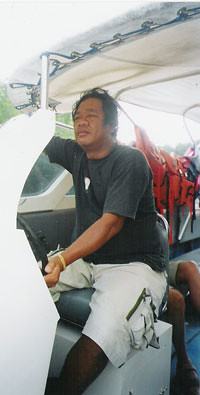
The speedboat driver was a guy named Lek, who in the grand tradition of Thais with nicknames looks the opposite of his name, which means small. Actually a beefy guy, Lek is not only an expert speedboat driver and navigator of the local waters, he's a tireless snorkeler. At one point during our day, he stopped to dive for clams, taking 30 minutes or so to fill three bushel baskets full to fill our plates at the evening meal. Again and again, he dove to the bottom to pick up more clams. And this was after two snorkeling jaunts earlier with the tour group. He also unloaded a trap, hauling aboard a single squid which he left on the deck of the boat to dry out and change colors before our very eyes. Presumably, it was served up for the evening meal as well.

Another thing about Lek: He never shuts up. But I mean this with all possible kindness. All day long, Lek chattered away good naturedly. He even talked through his snorkeling tube!

Lek's clams were the highlight of the second night's meal. The first night, there was plate after plate of crab. Darn, why didn't I take my camera to dinner? Co-owner Arthit boasted that other resorts charge extra if you ask for a second plate of crab. He supplies them free.

The only thing that costs extra is if the guests want alcoholic beverages beyond the single Spy wine cooler (split between two guests and poured in a classy wine glass) and a blue vodka and crush-ice cocktail provided at the first night's meal. I drank some non-alcoholic lemon shakes, provided free as part of the all-you-can-eat, all-you-drink (coffee, water, sodas) package.

Aside from snorkeling, big meals and time for early evening kayaking, the resort's other activities included a trip upstream to a waterfall. It was just a trickle at the time of year I visited, but there was a refreshing pool to swim in. One evening, a long-tail boat was pressed into use for a trip upstream to view the fireflies. Sparse at first, more and more were revealed in the treetops, until it looked like Christmas. They were still hard to see because it was nearly full moon.

A fun activity would have been a moonlight kayak paddle, or early morning paddle, but I was taking it easy this time out.

I was tipped off to Koh Kood by a friend who stayed at a new resort there on a part of the island that had no phone, no lights and no motorcars. So I was dismayed to find phone service, 24-hour electricity and roads on the part of the island I visited. There were also karaoke machines, stereos and cable televisions, making for a less-than-quiet holiday at times. But with the kayaking, the snorkeling and the food, everything evened out.

Note: Klong Chao Resort can be contacted through any number of hotel booking firms. Do a search on Google and take your pick, or try to contact the resort direct.

Friday, January 4, 2008

Kayaking on Koh Chang


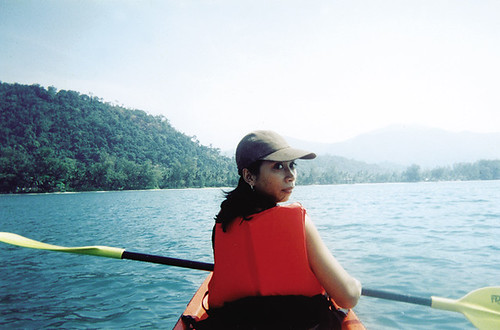
In December 2003, I had a chance to visit Koh Chang. Knowing nothing about the island, a friend had stayed at Chai Chet Bungalows, so I headed there. It proved to be an adequate choice, as they rent kayaks. The best deal for me was 12 hours for 400 baht. They also had 100-baht-an-hour rates, which is pretty expensive.

The boats were the ubiquitous Tri-Yaks from Feel Free. The guys at the bungalow kept trying to get me to sit in the very back position, not realizing the center seat is not for a third person but for a solo paddler. Thai people on holiday love to pile on to these little boats, but not me.

No matter. I went kayaking every day to my heart's content. Most of the hotels on the island had kayaks it seems, so it was a good place to go for a kayaking fix.

While I was there, a young couple from Seattle (one of whom hailed originally from Hopedale, Illinois) was there with their folding, inflatable Feathercraft - a great option that gives you total freedom to paddle whenever and wherever you want, as long as you can get to the water. Because they were so equipped, they were doing a lot of paddling, having boated over from White Sands Beach. They had paddled around Chai Chet Bay and the Klong Prao beach area for a few days, going "about as far as you can see out there". They were to move their operation to Lonely Beach and continue their exploration of the waters around Koh Chang.

I mainly stuck to Chai Chet Bay, exploring up Klong Prao as far as I could go. I also paddled way out into open water until I felt I could still turn back and make it. Coming back in, I bounced over the waves and imagined myself like the German submarine, the U-96 in Das Boot, when they are heading for the flotilla of American ships. The happy time. Politically and morally incorrect, but it kept me going.

Another day I paddled way out into open water and across to an island that I heard had some snorkeling. It was about an hour paddle and I was not disappointed. Indeed, there was snorkeling and there were snorkelers. There was even another pair of kayakers. But pretty soon I had the place to myself. The coral wasn't all that colorful, but a set of fins and a nice mask and snorkel loaned by a friend made going down and checking it all out a lot of fun.

For the last couple days of my visit to Koh Chang, my friend came to visit, and we did some more kayaking and snorkeling.

I found that staying in Chai Chet Bungalows wasn't perhaps the best. The staff seemed surly at first, but warmed up after I had stayed there a few days. Their English comprehension was limited - a bad sign for a resort that is seeing more and more foreign tourists. The 600 baht bungalows were very basic, with room for a bed and a small bathroom with squat toilet and cold, leaky shower hose. Made of concrete and tile, they were a bit sterile for my taste. There are a couple of other resorts on Chai Chet Bay, all about the same, though. There are some nicer resorts along Klong Prao beach, it looked like.

An idea for next time would be to ask for some extras when booking. If you want to do a lot of kayaking, ask that the kayak rentals be discounted or complimentary. Ask for a free breakfast, pickup at the ferry - anything. I asked for nothing and was offered nothing, so was nickled and dimed all the way for a ride to the hotel, for an hour's kayaking, for breakfast, for a cup of coffee, etc., etc., etc.

But I don't want to bitch too much. If anything, the rough edges around the tourist infrastructure were understable, as it was all new. Koh Chang has been having the hell developed out of it. Construction equipment clogs its narrow two-land blacktop. There's a ready mix plant on the island. A huge ferry brings more big trucks. There's garbage pickup as well as more garbage is coming in. An airport has been built in Trat by Bangkok Airways. So the quieter mode of tourism is giving way to bigger ways of doing things. Noise. Buses. Techno music. Crowds. Get there before all the quiet is gone.

Helpful link:

Thursday, January 3, 2008

Amphawa Now


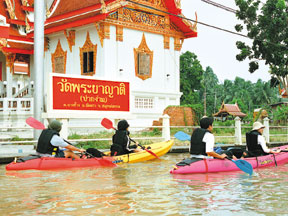
A group of Thai journalists took a tour of the village of Amphawa, Samut Songkhram Province, Thailand on November 12, 2002. The trip was sponsored by Joy Sports, a local provider of Feel Free kayaks, and Baan Tai Had Resort. The then-new resort gave tourists a mission: Paddle a kayak through the canals of the village and be drawn toward the charms of its people, their history and their way of life on the Mae Klong River. Here is the story I brought back from the trip:

"Never get out of the boat." Wiser words, from the character "Chef" in Apocalypse Now, have perhaps never been uttered in movie history.

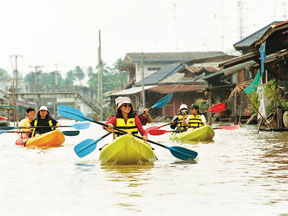
They certainly hold true in Amphawa where a new resort, Baan Tai Had, situated on the Mae Klong River, is promoting the eco-friendly sport of kayaking as a way for tourists to get into the stream of life in the sleepy Samut Songkhram province village.

The river is a metaphor for life's journey in Apocalypse Now. In the Vietnam war film, Chef and Martin Sheen's character take a walk into the jungle, leaving the Navy patrol boat that is ferrying them to Cambodia on a mission. Chef wants some mangoes, but gets more than he bargained for when a tiger chases them back out of the greenery.

There are no tigers in Amphawa. But then, there is no real reason to get out of your boat either as in this town, the river is life.

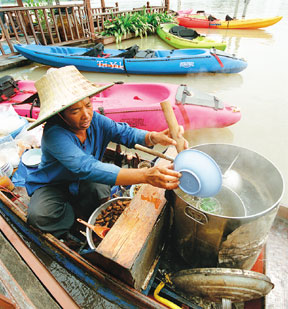
Everything is available on the water. If you want some noodles, there will likely be a noodle vendor in a boat, paddling her way down the canal, just when you are getting hungry. How about some ice cream? The ice-cream man drives a boat, too. Fresh vegetables? The water-borne hawker will be right along.

Or, you can tie up along the footpath at a shop and have what you want brought out to you.

Of course, there's no reason why you can't get out of your boat, since no tiger is likely to jump out at you.


In fact, there are plenty of reasons to get out of the boat, such as the preserved remains of the "miracle monk" at Wat Juramanee. The monk, Nung, was a much revered figure in the province, and when he died about 15 years ago, his body was placed in a glass casket and left to lie in state inside the wat's huge temple, the interior of which is painted in gold-leaf detailing.

If you stay in your boat, you'll never see the exquisite frescos in the temple at Wat Amphawa. The reconstructed paintings run from floor to ceiling and picture in great detail the goings on around the court of King Rama II, who was born in Amphawa. His history permeates the province and a great many of the numerous temples there go back to his time. Wat Amphawa is on the grounds of King Rama II Botanical Garden, which includes a museum set up in an old-style wooden house.

At least one temple in the province, Wat Ban Kung, goes back a bit further, to the Ayutthaya period. This was where King Thonburi brought his court to regroup after the fall of the old capital, before he came to Bangkok to establish a new capital. You have to go by road to see this one. It's a small temple that is made quite impressive by the huge, 300-year-old banyan tree that has spread its serpentine limbs up and over the structure, making it look like the temple was built inside the tree.

At another temple, Wat Bang Kai Noi, work has been going on for the past 10 years to install elaborately wood-carved illustrations of stories from Buddhist scripture. It's quite a sight to behold, and not far from the river. Thing is, you have to get out of your boat to see them.

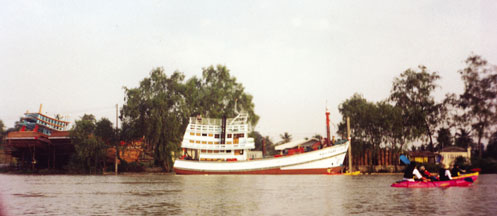
Of course, if you stay in your boat, you'll get to see the way of life in the town. You'll get a feeling that you are travelling back in time, as the old-style wooden buildings line the banks of the canal. It's quite a change from the concrete and steel structures that have taken over the landscape elsewhere in the Kingdom.

You'll see bemused expressions on the faces of residents as they watch you paddle past in your gaily coloured kayak. Or, because you are paddling silently along, without the noisy power of a long-tailed boat engine, you might scare a grandmother who is taking a bath in the river, and get to see her scurry away to cover before you get too close.

There's wildlife of the animal kind as well. Herons pass overhead, diving into the river for some fish. Emerald green flycatcher birds perch on the utility wires over the canal. They dive to the surface of the water, snatch up bugs and carry them back to the wire, where they beat the insects into submission with a few audible thwacks of their beaks on the cable.

The klongs in Amphawa are still very much active. Not having been blocked off and left to stagnate, the water is clean.

In late October and early November, a night-time boat trip on the Mae Klong comes with a light show, as fireflies are swarming in the trees and shrubbery along the shore. It's an unbelievable sight at first, as entire trees are aglow with flashing, yellow pinpoints of light. At first you might think someone has strung Christmas lights up in the trees, but there are so many it wouldn't be possible.

Tourism is still in its infancy in this province - a place where visitors pass through on their way to somewhere else. With the opening of Baan Tai Had Resort at the end of month, perhaps some tourists will find a reason to stop. Even then, the sights are more geared for Thai tourists, as little English is spoken and practically no literature is available in anything but Thai. But once the Thai tourists come, others will follow. And maybe they'll get off the boat.


Wednesday, January 2, 2008

In Amphawa, canals are the fastest way to get around


This is a story I wrote after a trip for work in 2002.

With more than 300 canals criss-crossing Samut Songkhram Province and the Mae Klong River, there are plenty of opportunities for boating.

Now, Baan Tai Had Resort promotes kayaking as a way of seeing the province.

"The way of life of the people of province depends on the river," says Patcharodom Unsuwan, the resort's managing director.

But rather than loading tour groups up in noisy, diesel-powered long-tail boats, Patcharodom wants visitors to get into a small boat and use a paddle to get around in the vast network of canals, known in Thai language as klongs (or khlongs).

A map of the klongs is in the works, he says. Until then, about the only hazard kayakers might face will be getting lost.

For those who know the way around, a trip from the resort to the centre of Amphawa takes only 15 minutes by non-motorised boat, via the canals. It's a distance of about 3.5 kilometres, compared to 5km by the river, or 10km by the narrow, winding, bumpy system of roads.

The type of kayaking that is being promoted is different from whitewater sport being undertaken by daredevils in Nakhon Nayok and other extreme places. About the only thing the two activities have in common is the two-bladed paddle.

In Samut Songkhram, it's an easy-going, leisurely activity. The kayaks themselves are easy to use and require no special techniques, such as the eskimo roll. In fact, the boats are quite stable and there's likely no chance of them tipping over. The current in the Mae Klong River and the klongs of Amphawa is negligible and easy to navigate. There are no rocks or rapids.

About the only obstruction would be the palm nuts bobbing on the water's surface. Tourism may not be a major revenue source in Samut Songkhram, but palm tree plantations and catching fish and giant, succulent shrimp from the Mae Klong River are livelihoods for many residents.

Baan Tai Had Resort is on the outskirts of Amphawa town. As of 2002, rates were Bt800 Sunday through Thursday. On Friday and Saturday, the rate is Bt940, a price that includes breakfast.

The resort has five kayaks available. Rental prices have yet to be set. Boat tours, a firefly-viewing dinner cruise and van trips to historical sites can be arranged. There are authentic floating markets in the province. The days they are held depend on the lunar cycle.
Comment: Do a Google search for "Baan Tai Had Resort" and you'll likely get any number of hotel-booking websites. Take your pick. Or, try to contact the resort direct.