Showing posts with label Thailand. Show all posts

Friday, January 4, 2008

Kayaking on Koh Chang


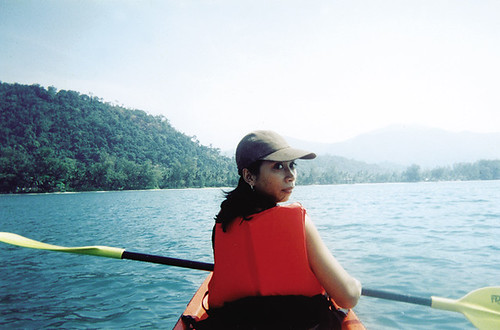
In December 2003, I had a chance to visit Koh Chang. Knowing nothing about the island, a friend had stayed at Chai Chet Bungalows, so I headed there. It proved to be an adequate choice, as they rent kayaks. The best deal for me was 12 hours for 400 baht. They also had 100-baht-an-hour rates, which is pretty expensive.

The boats were the ubiquitous Tri-Yaks from Feel Free. The guys at the bungalow kept trying to get me to sit in the very back position, not realizing the center seat is not for a third person but for a solo paddler. Thai people on holiday love to pile on to these little boats, but not me.

No matter. I went kayaking every day to my heart's content. Most of the hotels on the island had kayaks it seems, so it was a good place to go for a kayaking fix.

While I was there, a young couple from Seattle (one of whom hailed originally from Hopedale, Illinois) was there with their folding, inflatable Feathercraft - a great option that gives you total freedom to paddle whenever and wherever you want, as long as you can get to the water. Because they were so equipped, they were doing a lot of paddling, having boated over from White Sands Beach. They had paddled around Chai Chet Bay and the Klong Prao beach area for a few days, going "about as far as you can see out there". They were to move their operation to Lonely Beach and continue their exploration of the waters around Koh Chang.

I mainly stuck to Chai Chet Bay, exploring up Klong Prao as far as I could go. I also paddled way out into open water until I felt I could still turn back and make it. Coming back in, I bounced over the waves and imagined myself like the German submarine, the U-96 in Das Boot, when they are heading for the flotilla of American ships. The happy time. Politically and morally incorrect, but it kept me going.

Another day I paddled way out into open water and across to an island that I heard had some snorkeling. It was about an hour paddle and I was not disappointed. Indeed, there was snorkeling and there were snorkelers. There was even another pair of kayakers. But pretty soon I had the place to myself. The coral wasn't all that colorful, but a set of fins and a nice mask and snorkel loaned by a friend made going down and checking it all out a lot of fun.

For the last couple days of my visit to Koh Chang, my friend came to visit, and we did some more kayaking and snorkeling.

I found that staying in Chai Chet Bungalows wasn't perhaps the best. The staff seemed surly at first, but warmed up after I had stayed there a few days. Their English comprehension was limited - a bad sign for a resort that is seeing more and more foreign tourists. The 600 baht bungalows were very basic, with room for a bed and a small bathroom with squat toilet and cold, leaky shower hose. Made of concrete and tile, they were a bit sterile for my taste. There are a couple of other resorts on Chai Chet Bay, all about the same, though. There are some nicer resorts along Klong Prao beach, it looked like.

An idea for next time would be to ask for some extras when booking. If you want to do a lot of kayaking, ask that the kayak rentals be discounted or complimentary. Ask for a free breakfast, pickup at the ferry - anything. I asked for nothing and was offered nothing, so was nickled and dimed all the way for a ride to the hotel, for an hour's kayaking, for breakfast, for a cup of coffee, etc., etc., etc.

But I don't want to bitch too much. If anything, the rough edges around the tourist infrastructure were understable, as it was all new. Koh Chang has been having the hell developed out of it. Construction equipment clogs its narrow two-land blacktop. There's a ready mix plant on the island. A huge ferry brings more big trucks. There's garbage pickup as well as more garbage is coming in. An airport has been built in Trat by Bangkok Airways. So the quieter mode of tourism is giving way to bigger ways of doing things. Noise. Buses. Techno music. Crowds. Get there before all the quiet is gone.

Helpful link:

Thursday, January 3, 2008

Amphawa Now


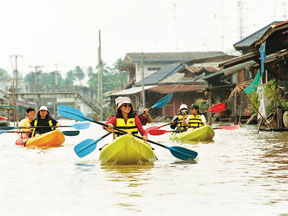
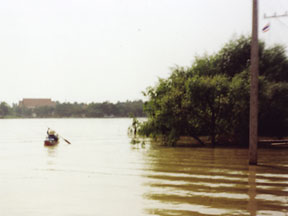
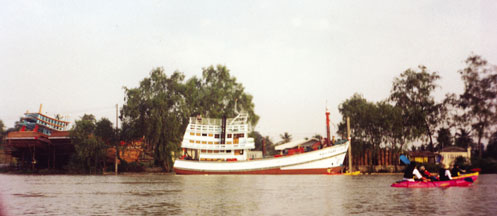
A group of Thai journalists took a tour of the village of Amphawa, Samut Songkhram Province, Thailand on November 12, 2002. The trip was sponsored by Joy Sports, a local provider of Feel Free kayaks, and Baan Tai Had Resort. The then-new resort gave tourists a mission: Paddle a kayak through the canals of the village and be drawn toward the charms of its people, their history and their way of life on the Mae Klong River. Here is the story I brought back from the trip:

"Never get out of the boat." Wiser words, from the character "Chef" in Apocalypse Now, have perhaps never been uttered in movie history.

They certainly hold true in Amphawa where a new resort, Baan Tai Had, situated on the Mae Klong River, is promoting the eco-friendly sport of kayaking as a way for tourists to get into the stream of life in the sleepy Samut Songkhram province village.

The river is a metaphor for life's journey in Apocalypse Now. In the Vietnam war film, Chef and Martin Sheen's character take a walk into the jungle, leaving the Navy patrol boat that is ferrying them to Cambodia on a mission. Chef wants some mangoes, but gets more than he bargained for when a tiger chases them back out of the greenery.

There are no tigers in Amphawa. But then, there is no real reason to get out of your boat either as in this town, the river is life.

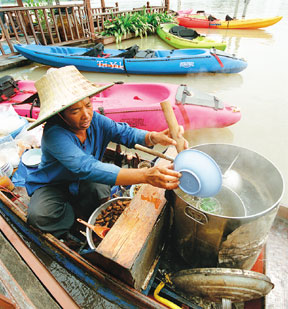
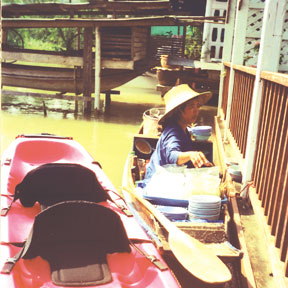
Everything is available on the water. If you want some noodles, there will likely be a noodle vendor in a boat, paddling her way down the canal, just when you are getting hungry. How about some ice cream? The ice-cream man drives a boat, too. Fresh vegetables? The water-borne hawker will be right along.

Or, you can tie up along the footpath at a shop and have what you want brought out to you.

Of course, there's no reason why you can't get out of your boat, since no tiger is likely to jump out at you.


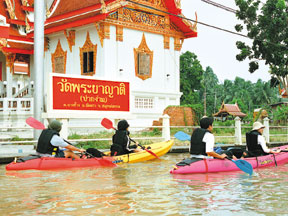
In fact, there are plenty of reasons to get out of the boat, such as the preserved remains of the "miracle monk" at Wat Juramanee. The monk, Nung, was a much revered figure in the province, and when he died about 15 years ago, his body was placed in a glass casket and left to lie in state inside the wat's huge temple, the interior of which is painted in gold-leaf detailing.

If you stay in your boat, you'll never see the exquisite frescos in the temple at Wat Amphawa. The reconstructed paintings run from floor to ceiling and picture in great detail the goings on around the court of King Rama II, who was born in Amphawa. His history permeates the province and a great many of the numerous temples there go back to his time. Wat Amphawa is on the grounds of King Rama II Botanical Garden, which includes a museum set up in an old-style wooden house.

At least one temple in the province, Wat Ban Kung, goes back a bit further, to the Ayutthaya period. This was where King Thonburi brought his court to regroup after the fall of the old capital, before he came to Bangkok to establish a new capital. You have to go by road to see this one. It's a small temple that is made quite impressive by the huge, 300-year-old banyan tree that has spread its serpentine limbs up and over the structure, making it look like the temple was built inside the tree.

At another temple, Wat Bang Kai Noi, work has been going on for the past 10 years to install elaborately wood-carved illustrations of stories from Buddhist scripture. It's quite a sight to behold, and not far from the river. Thing is, you have to get out of your boat to see them.

Of course, if you stay in your boat, you'll get to see the way of life in the town. You'll get a feeling that you are travelling back in time, as the old-style wooden buildings line the banks of the canal. It's quite a change from the concrete and steel structures that have taken over the landscape elsewhere in the Kingdom.

You'll see bemused expressions on the faces of residents as they watch you paddle past in your gaily coloured kayak. Or, because you are paddling silently along, without the noisy power of a long-tailed boat engine, you might scare a grandmother who is taking a bath in the river, and get to see her scurry away to cover before you get too close.

There's wildlife of the animal kind as well. Herons pass overhead, diving into the river for some fish. Emerald green flycatcher birds perch on the utility wires over the canal. They dive to the surface of the water, snatch up bugs and carry them back to the wire, where they beat the insects into submission with a few audible thwacks of their beaks on the cable.

The klongs in Amphawa are still very much active. Not having been blocked off and left to stagnate, the water is clean.

In late October and early November, a night-time boat trip on the Mae Klong comes with a light show, as fireflies are swarming in the trees and shrubbery along the shore. It's an unbelievable sight at first, as entire trees are aglow with flashing, yellow pinpoints of light. At first you might think someone has strung Christmas lights up in the trees, but there are so many it wouldn't be possible.

Tourism is still in its infancy in this province - a place where visitors pass through on their way to somewhere else. With the opening of Baan Tai Had Resort at the end of month, perhaps some tourists will find a reason to stop. Even then, the sights are more geared for Thai tourists, as little English is spoken and practically no literature is available in anything but Thai. But once the Thai tourists come, others will follow. And maybe they'll get off the boat.


The noodle lady of Amphawa

Floating markets are popular tourist draws in Thailand. There are a lot of very colorful pictures of them, with women in traditional Thai clothing - big straw hats and such - paddling small boats laden with produce, food and handicrafts. Some are said to be tourist contrivances, but I don't really know about that. They remain popular, that's for sure, and are one of the most common items on a lot of tourists' itineraries.

One of the more authentic floating markets is in Amphawa, on the Mae Klong River in Samut Songkhram Province, Thailand. I understand it is only held at a certain time of the month, in line with the lunar calendar, probably due to the tides on the ocean. I don't really know more than that, okay?

What I do know for sure is when I visited Amphawa in 2002, there was regular everyday trading going on from boats. Merchants were using boats to cart produce around. One guy was selling ice cream from his boat.

And I ate noodles from a noodle lady in a small boat. She cooked with propane but paddled her boat around, searching for hungry people and selling noodles. I don't remember how much the noodles cost, but they were cheap.

Wednesday, January 2, 2008

In Amphawa, canals are the fastest way to get around


This is a story I wrote after a trip for work in 2002.

With more than 300 canals criss-crossing Samut Songkhram Province and the Mae Klong River, there are plenty of opportunities for boating.

Now, Baan Tai Had Resort promotes kayaking as a way of seeing the province.

"The way of life of the people of province depends on the river," says Patcharodom Unsuwan, the resort's managing director.

But rather than loading tour groups up in noisy, diesel-powered long-tail boats, Patcharodom wants visitors to get into a small boat and use a paddle to get around in the vast network of canals, known in Thai language as klongs (or khlongs).

A map of the klongs is in the works, he says. Until then, about the only hazard kayakers might face will be getting lost.

For those who know the way around, a trip from the resort to the centre of Amphawa takes only 15 minutes by non-motorised boat, via the canals. It's a distance of about 3.5 kilometres, compared to 5km by the river, or 10km by the narrow, winding, bumpy system of roads.

The type of kayaking that is being promoted is different from whitewater sport being undertaken by daredevils in Nakhon Nayok and other extreme places. About the only thing the two activities have in common is the two-bladed paddle.

In Samut Songkhram, it's an easy-going, leisurely activity. The kayaks themselves are easy to use and require no special techniques, such as the eskimo roll. In fact, the boats are quite stable and there's likely no chance of them tipping over. The current in the Mae Klong River and the klongs of Amphawa is negligible and easy to navigate. There are no rocks or rapids.

About the only obstruction would be the palm nuts bobbing on the water's surface. Tourism may not be a major revenue source in Samut Songkhram, but palm tree plantations and catching fish and giant, succulent shrimp from the Mae Klong River are livelihoods for many residents.

Baan Tai Had Resort is on the outskirts of Amphawa town. As of 2002, rates were Bt800 Sunday through Thursday. On Friday and Saturday, the rate is Bt940, a price that includes breakfast.

The resort has five kayaks available. Rental prices have yet to be set. Boat tours, a firefly-viewing dinner cruise and van trips to historical sites can be arranged. There are authentic floating markets in the province. The days they are held depend on the lunar cycle.
Comment: Do a Google search for "Baan Tai Had Resort" and you'll likely get any number of hotel-booking websites. Take your pick. Or, try to contact the resort direct.

Welcome to Kayaking in Thailand

Canoeing was a favorite activity when I was living in the United States. Now, living and working in Thailand, it's harder to get out of the office and do some paddling. Still, I've managed to get out on a few trips.