Showing posts with label hotel. Show all posts

Monday, January 14, 2008

Snorkeling the Surin Islands


In April 2007, I had a chance to visit the Surin Islands, the first time in a long time I had embarked on any type of adventure travel in Thailand.

This trip would mark my second flight to Phuket, the first being in November 2004, for a kayaking trip with John Gray.

This time around, I flew from Bangkok to Phuket on Thai Air Asia, and the check-in at the airport and the flight were all without any mishaps.

Arriving on a mid-morning flight, at Phuket, I was met by a driver, provided by a tour agency I had contacted over the Internet. From the airport, I and my friend would be put up for the night at a hotel in Khao Lak.

About 90 minutes from the airport, Khao Lak was one of the areas of Phuket that was especially hard hit by the 2004 tsunami, but there wasn't any evidence of it. The area seemed quite well developed, with plenty of hotels, resorts, guesthouses and shops.

The hotel I was staying in, Tony Lodge, is a small boutique hotel, wedged between a couple of others. The website is a pretty accurate depiction of the place, as it offers no scenic view to speak of. But the rooms are comfortable and well-appointed. The beach is across the highway and down a lane, perhaps a 15-minute walk, or the advertised five minutes if you hire a motorbike.

We did visit the beach, and I had a chance to show my friend a bit about how to use the snorkeling gear.

Pretty soon though, it was time for sleep and an early morning call to be taken to Kuraburi pier by van, which was provided in the tour-package price.

This is when the sheer distance and scale of the Phuket area dawned on me. To get from area to area around Phuket, you have to have transport, and on Phuket, transport is going to be a hassle and it's going to be expensive.

After about a two-hour ride in the van, we reached Kuraburi. Here is where I discovered I had a problem with the booking agency I hired. I had actually hired a company that then booked with another company that was doing the actual package. I should have been dealing with them direct, instead of this intermediary. Due to the miscommunication, I was not going to be given a bungalow on Surin Island as requested, but I would have to sleep in a tent, at least one night.

Now, I've been in Thailand long enough to know that I should not show anger. Strong displays of emotion are not polite in any society, but in Thailand it is the height of rudeness. But the breakfast of dry toast and instant coffee had left me a bit grumpy, so it didn't take much to upset me.

Luckily, one of the workers at the desk didn't do the usual routine of shutting down and becoming unresponsive. Instead, she wanted me to stop being angry and said she would take care of the problem.

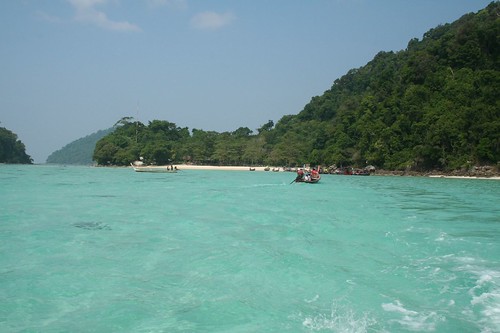
As we boarded a speedboat, and hit the open water, my negative emotions subsided with the fresh sea air and the sight of the clear, blue waters of the Andaman Sea.


Mu Ko Surin is a national marine park of Thailand. It is open for tourists from November to May, so we were getting there just at the end of the season.

As the boat approached the island, the helpful Kuraburi Greenview staffer informed me that she'd straightened out the mess with the bungalow after all. What a relief! I really didn't want to sleep in a tent, and deal with a shared latrine and shower house.

The accommodation at this national park is more rustic than I'd seen in previous trips, and I can readily say that if you go to Koh Surin, make sure you get a bungalow, unless you are used to sleeping in tents and dealing with a dark, pit toilet and crude shower huts.

Checked in, and everything as much to my satisfaction as I could expect, we were served a light lunch, communal style at the park canteen. Here, we would meet our guides for the three-day, two-night package, and they would attend to all our needs, serving our meals and making sure we got on the boat for snorkeling.

That afternoon, we hit some snorkeling spots not far from the dock. It was just the right amount of snorkeling, with some great views of colorful coral and fish.

After an evening meal, it was time for bed, and then up again around 6.30 or 7am for breakfast.

After a morning snorkel, there was a visit to a Moken (sea gypsy) community. I felt like an intruder, as if we tourists were sullying a traditional way of life. There was a school and medical clinic at the settlement.

During an afternoon snorkeling session, one of the guides caught a sea turtle. I had earlier seen it, thinking I was just looking a rock. But something about it looked different, and then the rock moved and swam away at high speed. I was amazed the guide had captured the creature, which probably measured about 18 inches long and 10 inches wide.

On another dive, I caught a fleeting glimpse of a large eel.

The second evening, there was some time before dinner, so I grabbed one of the park's kayaks, available for an hour's rental for 100 or 200 baht. My friend and I rode double, and we paddled around the mouth of bay and along the back side of the island in a narrow inlet betwen the main island and another. We did perhaps an hour or two of paddling - nothing spectacular, but a great way to pass the time.

The next morning we got to go for one more snorkel. We visited a second campsite on the island, not far from where we'd paddled the kayak the day before. And then we visited another deep bay with some decent coral. I spent a lot of time diving down as deep as I could stand and then resurfacing, and kept doing so until it was time to leave.

That afternoon, the speedboat from the mainland brought a fresh load of tourists, and we caught the boat back to the mainland.

Once returned, and changed out of swimshorts and wet clothes, we caught the van back to Phuket, for a long late afternoon and evening of driving, from van, back to Tony Lodge, where we met the original tour agency's driver, and then a long drive back to Phuket airport.

All in all, a great trip, tainted some by the aggravation of the miscommunication about the bungalow reservation.

Would I do it over again, I would deal with the primary tour agency direct. This is Kuraburi Greenview. In addition to Surin Island, they also run tours to the Similan Islands.

Kuraburi can also be reached via Krabi, which is also served by an airport.

(Photo credit: Darlene is Evil via Flickr)

Saturday, January 12, 2008

The Big One: Tsunami strikes Phuket


On December 26, 2004, a tsunami hit Phuket, Thailand and the Indian Ocean region. More than 120,000 deaths were reported. Among the survivors was John Gray, founder of John Gray's Sea Canoe, who recounts that fateful morning.

The tremors started at 07:58am. The long, low frequency shakes lasted for two minutes. It wasn’t the shattering, sharp jolt one expects from a California quake, but the feeling was ominous. The length and frequency said this quake was a long way off, and very strong. I also knew from my Phang Nga Bay geology research that any active fault-lines were to the west of Phuket, in the Indian Ocean. The tremors lasted long enough to put a bowl of water on the floor to verify the shakes. Sure enough, the water was rippling.

Once the tremors stopped, I mentioned tsunami, but the novelty of an earthquake – successfully survived – was euphoric. Everybody laughed while I talked about the ‘Big One’. We still knew nothing about the quake and its direction, only that it was a long way off.

There hasn’t be a significant tsunami since 1883, when the Indonesian island of Krakatoa exploded. It was volcanic in origin and generations past. Official reports say 36,000, but we know that perhaps 500,000 died in the unnamed coastal villages of a century past. If there was a tsunami, Hawaii’s history says that lack of awareness not only adds to the danger, it is the danger.

On the Internet, I immediately went to the U.S. Geological Service. Only 15 minutes after the shake, there it was – 8.3 tremor off the west coast of Sumatra. This was a Biggie. It grew to 9.0 – massive – and an aftershock was 7.3.

The Indian Ocean doesn’t have a warning system, so my next stop was Pacific Tsunami Warning Center. Their words were prophetic but typically bureaucratic. An “Event” occurred in the Indian Ocean west of Sumatra, but would have no impact upon the Pacific Basin. Thanks for the news, guys.

Maybe Australia. This “event” could impact Western Australia. I e-mailed the Australia Meteorology Bureau at exactly 9:00am:

Any info on this morning's Sumatra quake and possible tsunami generation? If any tsunami were generated I need to know fast?

The response took 24 minutes. Not bad, but not good enough.

Dear Ling Yai,

We have received an advice from the Tsunami Warning Center in Hawaii. They opine that a tsunami threat does not exist for the Pacific. However, they do not discount the possibility of a tsunami near the epicenter, which was off the west coast of Northern Sumatra.
We have no further information.

A few minutes later, the wave hit.

My response was not as polite.

Sawasdee,

I read the same advisory from Hawaii. By now you have the news on the devastating tsunami here in Thailand and SE Asia. As a 20-year Hawaii resident and Chairman, Coastal resources Committee of the Hawaii Marine Master plan from 1986-90, I am well acquainted with the Pacific Basin Long-range alert system. Now that the Barn Door is open and hundreds have lost their lives, maybe it's time for one in the Indian Ocean. From even before I came to Thailand I was well aware of the Sumatra/Andaman fault line and it's potential for generating tsunami's. If a simple-minded Big Monkey can see the future - and now the result, It’s time to develop a similar international system for the Indian Ocean. Very frustrating for me to see today's fatalities - all due to lack of warning and education.

Ling Yai

Between e-mails, I called three hotels to watch for receding waters. On Sunday morning after Christmas, I was unable to contact any managers so I called my guide staff together, told them to watch for rapidly receding waters and sent them out to pick up our guests. I told my escort boat captain to move from the pier to deep waters.

Reports soon came from Patong and Bang Tao. My Patong transfer guide saw the wave hit. I told him to get over the hill. My Bang Tao transfer guide reported he couldn’t reach the hotel for the devastation.

I reminded everybody to look for receding waters and go to Ao Po, on Phuket’s East Coast. I soon got a phone call that waters in Ao Po were dropping fast. My wife told them to evacuate immediately. They got our guests off the pier office with grace and speed, and warned the waterfront shopkeepers to run up the hill. Our escort boat shook from the tsunami but survived. Nobody in Ao Po was hurt. If the tsunami wrapped around to the northeast corner of Phuket, it was a biggie. My prediction of hundreds dead immediately changed to thousands.

I was surprised that the wave wrapped around Sumatra’s North Point with such strength. Sri Lanka and India were in the direct line of fire, but Phuket was a 70-degree turn for any defocused waves. Thousands died – we will never know how many – but the blessing was that the tsunami was seriously depleted in relation to the full strength version that hit Sri Lanka.

Any low-lying area was serious trouble. Patong took a strong hit, and we’ve all seen the videos of rivers rushing down the sois. From the geography it was obvious that the further north the wave went, the stronger it was. Bang Tao simply exploded. Shops behind the hotels have pick-up trucks in their showrooms. Laguna wasn’t as bad because the beach is a bit higher and the hotels are setback from the beaches (a trend started by environmental planning).

At J.W. Marriott, the alert food and beverage manager was on the beach. He didn’t understand the ocean’s drop, but he did have the presence to evacuate the beach, saving everybody in front of the hotel. Just further north, 30 beachgoers died at a luxury hotel without a similar warning. Worst hit was the fairly new resort of Khao Lak, set right on the beach.

My survey from Khao Lak to Kata Noi was predictable. Any hotel set up ten meters or more on a cliff, bluff or mountainside escaped devastation. Windows were broken and guests were terrified, but disaster passed below.

It was simply the luck of the draw. Millionaires in low-lying beachfront villas were swamped, backpackers in off-the-beach bungalows unaffected.

Thailand will bounce back fairly soon.

Hotels cleaned out their lobbies are already for check-in.

We ran a sea canoe daytrip for 20 people on December 28 -- only 40 hours after the tsunami. Pa Nga Bay was calm and beautiful. A lizard swam the still waters at the base of majestic cliffs.

On December 30 I took an overnight trip with Hawaii people who grew up with tsunamis. We know the Big One can be devastating and deadly, but once it’s gone, it’s gone.

It’s time to recover. The best assistance Thailand can get is tourism support.

I was amazed at how professional the police, military and disaster services were. Thousands of Thais performed as professional who would make Hawaii Civil Defense system jealous. With no tsunamis for generations, the Indian Ocean basin may have slept through the warning signs, but Thailand can be proud of our very professional reaction to this terrible time.

What is over is over. Thailand is not Sri Lanka. Water is clean, rescue and clean-up well organized. 200 metes behind the beach, life goes on. Need drinking water? The big department stores and a thousand local shops can sell you some. Restaurants are already back in business. The clean up will be a matter of weeks.

What the Kingdom really needs now is for those who loved us the first time around to return and give their support.

Knowing Thai people, we will welcome you with open arms.

(Photo credit: Electrostico via Flickr)